
Five state governments spent April and May promising cash transfers they could not yet fully cost. The fiscal terms that determine whether they can keep those promises- a frozen devolution share, a lapsed compensation cess, a shrinking divisible pool- were set months before a single vote was cast, in rooms none of the winning parties controlled.
In the winter of 2019, I sat in a share-cropper's courtyard in Bardhaman, waiting for a woman named Krishna Bala to finish counting notes she had just collected from the local Lakshmir Bhandar disbursement point. She counted twice. It was Rs 500 then, before the 2021 election doubling, and she folded the notes into a cloth pouch kept inside her blouse rather than a purse, because a purse could be lost on the bus back from the block office. I was there for a land reform survey, not a welfare study, but the scene has stayed with me because of how ordinary it was. Nobody in that courtyard talked about fiscal federalism. They talked about whether the amount would rise before the next election, and whether it would still be there after.
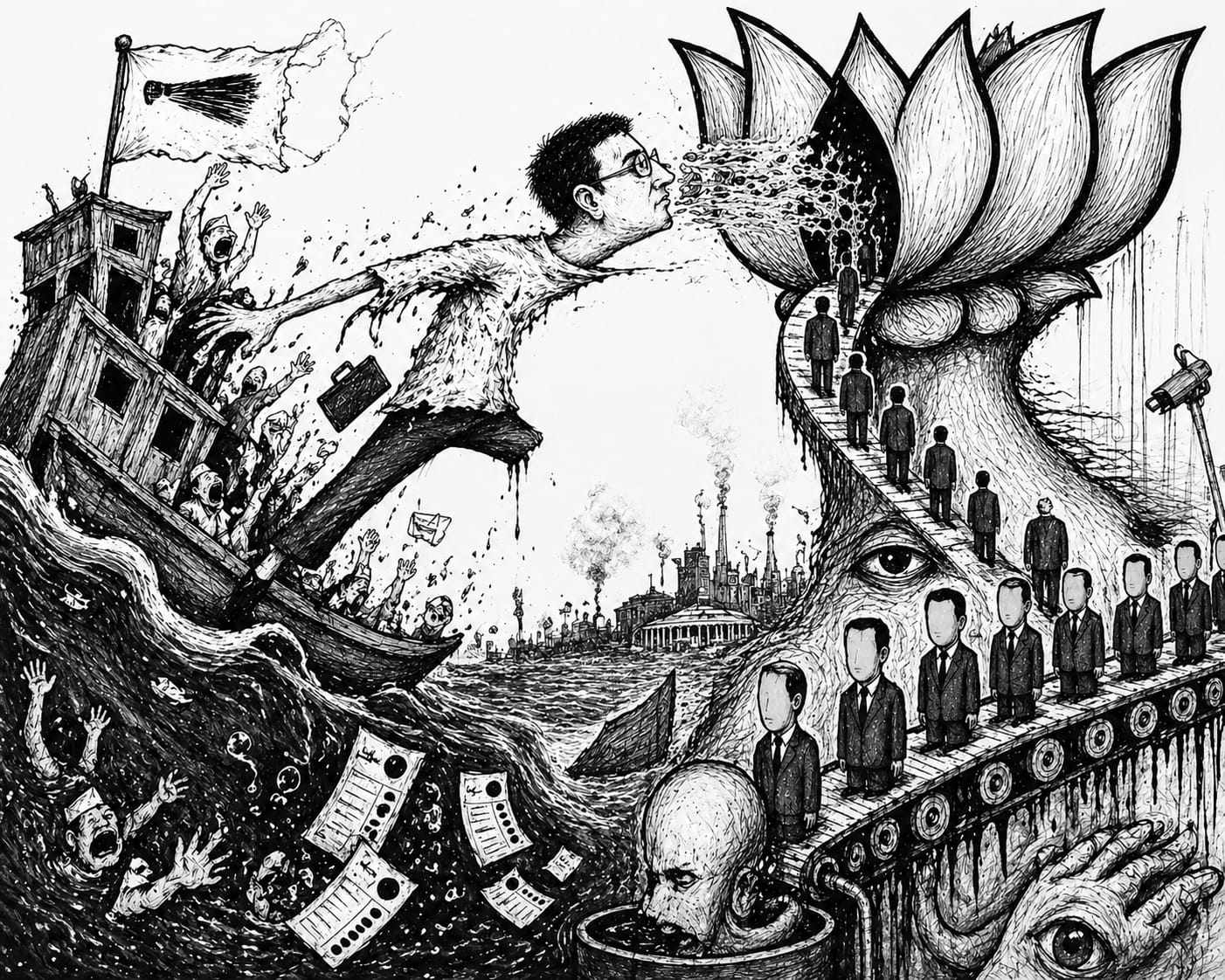
It is still there, though not for everyone who once received it. In May 2026, after Suvendu Adhikari's BJP unseated Mamata Banerjee's Trinamool Congress in a landslide that flipped 207 of West Bengal's 294 seats, the new government kept Krishna Bala's payment, renamed it Annapurna Bhandar, and raised it to a flat Rs 3,000 a month for every eligible woman. A party that had spent a decade attacking cash transfers as clientelism inherited one, found it politically binding, and enlarged it, while narrowing who qualifies in ways the headline figure does not show. Both things are true at once, and the gap between them is where this essay begins.
This essay is about what happens when five newly elected state governments, four of them replacing the party that lost, try to fund an unusually expensive round of welfare guarantees at the exact moment the Union government has already locked in the fiscal terms under which they must do it. The 2026 assembly elections in Assam, Kerala, Tamil Nadu, West Bengal and Puducherry produced results dramatic enough to dominate a fortnight of headlines, an actor breaking a sixty-year duopoly in Tamil Nadu, the CPI(M)'s worst defeat in Kerala since 1977, a scoreline in Bengal that inverted 2021 seat for seat. But the fiscal terms that will decide whether any of these mandates can be honoured were finished earlier and elsewhere, in the Sixteenth Finance Commission's report and the GST Council's cess deliberations. States choose who governs them. Since the 2000 constitutional amendment that carved cesses and surcharges out of the divisible pool, they have had progressively less say over how much money that government actually has to work with.
What five states actually promised
The results themselves were not close. In Kerala, the Congress-led UDF won 102 of 140 seats, its biggest mandate since 1977, unseating thirteen of the CPI(M)-led LDF's sitting ministers, including the health minister; V.D. Satheesan replaced Pinarayi Vijayan as chief minister. In Tamil Nadu, C. Joseph Vijay's two-year-old Tamilaga Vettri Kazhagam took 108 of 234 seats to become the single largest party, ending the DMK-AIADMK duopoly that had run unbroken since the 1960s; Vijay was sworn in on 10 May and survived a trust vote 144 to 22 after roughly two dozen AIADMK legislators crossed the floor. In West Bengal, the BJP won 207 seats against the Trinamool's 80, with Suvendu Adhikari beating Mamata Banerjee by 15,105 votes in her own Bhabanipur constituency on a turnout close to 94 per cent, the highest recorded for an Indian state election. Assam alone rewarded its incumbent: Himanta Biswa Sarma's BJP-led NDA won a clear majority, and Puducherry's NDA coalition returned N. Rangaswamy as chief minister for a fifth term.
What unites all five contests, regardless of which party won, is the instrument each side reached for. Every winning coalition ran on a large cash transfer to women, priced in the low thousands of rupees a month, alongside a scatter of sector-specific promises whose costings range from precise to nonexistent.
Assam's BJP promised to raise Orunodoi, its existing transfer to roughly 19 lakh women, from Rs 1,250 to Rs 3,000 a month while extending it to 15 lakh additional households, several times over, a scheme that currently costs the state around Rs 2,625 crore a year. Assam is, on every fiscal indicator available, the least stretched of the five states, with debt at roughly 24 per cent of GSDP, and it is the only one of the five where the promise lands on ground with real room to absorb it.
Kerala's UDF promised the most and cost the least. Its "Indira guarantees" include free bus travel for women on KSRTC, a monthly stipend for college-going girls, a health insurance scheme, interest-free small-business loans, and a raise in the welfare pension to Rs 3,000, alongside a separate proposal called NYAY, offering Rs 6,000 a month to the poorest BPL households. I could not find a published annual cost for either NYAY or the pension increase, not from the UDF, not from an independent economist, not from any financial daily I checked. A government that has just inherited a fiscal deficit target of 3.2 per cent of GSDP and has committed expenditure eating up three-quarters of its revenue receipts owes its electorate a number, at a minimum.
Tamil Nadu's TVK inherited the DMK's Kalaignar Magalir Urimai Thogai, a Rs 1,000-a-month payment that cost the state Rs 13,807 crore in the 2025-26 budget covering roughly 1.15 crore women, and promised to raise it to Rs 2,500. As of the middle of 2026, the increase had not been implemented; the Rs 1,000 payment continues. The manifesto's other headline commitment, a full crop loan waiver for farmers holding under five acres, has so far materialised as a scheme covering roughly Rs 2,044 crore and 14.22 lakh farmers, a fraction of the AIADMK's 2021 waiver of Rs 12,110 crore across 16.43 lakh farmers. Edappadi Palaniswami has called the gap a betrayal, and on the arithmetic he has a case.
West Bengal's BJP is the state where the promise-versus-delivery question is most legible, because the government has actually published a number. The old Lakshmir Bhandar scheme, at its last count, covered roughly 2.4 crore women at a tiered Rs 1,500 to Rs 1,700 a month. Annapurna Bhandar, notified on 19 May 2026 and launched from 3 June, pays a flat Rs 3,000 a month, Rs 36,000 a year, and the FY2026-27 budget presented on 22 June allocated Rs 36,000 crore to the scheme. At first glance, that looks like a straightforward doubling of the transfer on the same base of beneficiaries. It is not. Rs 36,000 crore divided by an annual per-beneficiary cost of Rs 36,000 implies budgeted coverage of almost exactly one crore women, less than half of Lakshmir Bhandar's last enrolled base. The eligibility rules explain why.
Annapurna Bhandar excludes income-tax payers and government employees and pensioners, categories Lakshmir Bhandar had not screened as tightly, and it layers a citizenship and residency check onto the Special Intensive Revision of the electoral rolls that ran through Bengal ahead of the poll, a process I have written about at length in Eleven Years, Six Asks. By 1 July, when Chief Minister Adhikari announced the second disbursement at Netaji Indoor Stadium, the government confirmed that roughly 26 lakh of the 1.6 crore applications received had been rejected, primarily due to doubts about citizenship and domicile status. A separate exemption preserves benefits for women who have appealed their SIR deletion to the tribunal or applied for citizenship under the CAA, so the exclusion is not absolute, but the direction of travel is unmistakable.
West Bengal has not so much doubled a welfare payment as redesigned who counts as a claimant on the state and priced the redesign in rupees. I examined the earlier, cruder version of this same manoeuvre, a conditional citizenship-linked transfer scheme launched a month after the poll, in The Cash and the Category; Annapurna Bhandar is that logic formalised into a budget line.
PRS Legislative Research counts 12 states now running some version of a large cash transfer to women, at a combined cost of Rs 1,68,040 crore, roughly half a percentage point of GDP, with 6 of those 12 already running revenue deficits. A senior Bengal BJP functionary, explaining the party's own reversal on cash transfers to a reporter after the results, said the scheme had become an election tool across the country, a description considerably more honest than most manifestos that put it into practice.
The Sixteenth Finance Commission finished its work before the votes were counted
The fiscal terms binding these five governments for their full five-year terms were not decided in May. They were decided the previous November. The Sixteenth Finance Commission, chaired by Arvind Panagariya, submitted its report to President Droupadi Murmu on 17 November 2025, and it was tabled in Parliament alongside the Union budget on 1 February 2026, covering the award period 2026-27 to 2030-31. Every state that went to the polls in April and May knew, or should have known, the fiscal envelope it was campaigning inside.
The headline disappointed every finance ministry that had lobbied for more: vertical devolution, the share of the divisible pool passed to states as a bloc, stayed at 41 per cent, unchanged from the Fifteenth Commission, against a demand from eighteen states for 50 per cent. What changed was the horizontal formula, the rule for splitting that fixed 41 per cent among states, which for the first time gives explicit weight to economic output. The Commission introduced a new 10 per cent criterion for a state's contribution to national GDP, replacing the Fifteenth Commission's tax-and-fiscal-effort measure, alongside income distance at 42.5 per cent, 2011 Census population at 17.5 per cent, a redefined demographic performance measure at 10 per cent, area at 10 per cent, and forest and ecology at 10 per cent.
The effect on the southern states that just elected new governments is real, if modest. Karnataka gained the most of any state, rising 0.48 percentage points; Kerala gained the second most, rising from 1.925 to 2.382 per cent of the divisible pool; Andhra Pradesh and Telangana each gained fractionally; Tamil Nadu's share moved from 4.079 to 4.097 per cent, a change too small to register in a single budget line. Uttar Pradesh and Bihar both lost share. The older southern grievance, that basing population weight on the 2011 Census penalises states that succeeded early at family planning, has not gone away: Kerala's population share fell from 3.89 per cent in the 1971 count to 2.76 per cent in 2011, and the new demographic performance weighting offsets only part of that swing.
What matters more than the horizontal reshuffle is what the Commission took away. Revenue-deficit grants, sector-specific grants and state-specific grants, the categories the Fifteenth Commission had used to cushion states running structural deficits, were discontinued outright. In their place: Rs 8 lakh crore for local bodies over five years, split roughly 55-45 between rural and urban, Rs 2.04 lakh crore for disaster management, and two smaller new instruments, a Special Infrastructure Grant worth Rs 56,100 crore and an Urbanisation Premium worth Rs 10,000 crore. For Kerala's finance ministry, which spent much of 2025 warning about fiscal collapse, the removal of the one grant category built specifically for a state in its position is arguably more consequential than anything in the horizontal formula, and it drew markedly less coverage.
The Commission also imposed discipline that binds all five new governments, regardless of how each feels about its share. State fiscal deficits are capped at 3 per cent of GSDP annually. Off-budget borrowing, the practice of routing state debt through public sector undertakings and special purpose vehicles to keep it off the headline balance sheet, is to end, with the definition of state debt widened to capture what had previously escaped it. DISCOM debt is to be parked in separate vehicles ahead of privatisation, and 308 inactive state public enterprises, loss-making for three of the last four years, face review or closure. None of this is exotic by international public finance standards. It is, however, a binding constraint on the room any of these five governments has to fund what it just promised, and the constraint predates the promise.
The subsidy chapter is worth reading closely for its own sake. The Commission flagged that unconditional cash transfers had grown from a small share of total state subsidy spending to 20.2 per cent by 2025-26, and warned explicitly against the design flaws of such schemes, the absence of exit criteria, income testing or sunset clauses, that distinguish them from targeted social spending. It also recommended that the Union annually disclose CAG-certified net tax proceeds data under Article 279, a transparency measure the government has accepted, specifically to address the trust deficit around how much of the divisible pool states are actually owed. A constitutionally mandated commission does not ask for better accounting of a mechanism unless that mechanism has grown large enough to need it.
The pool keeps shrinking, and the mechanism is not a mystery
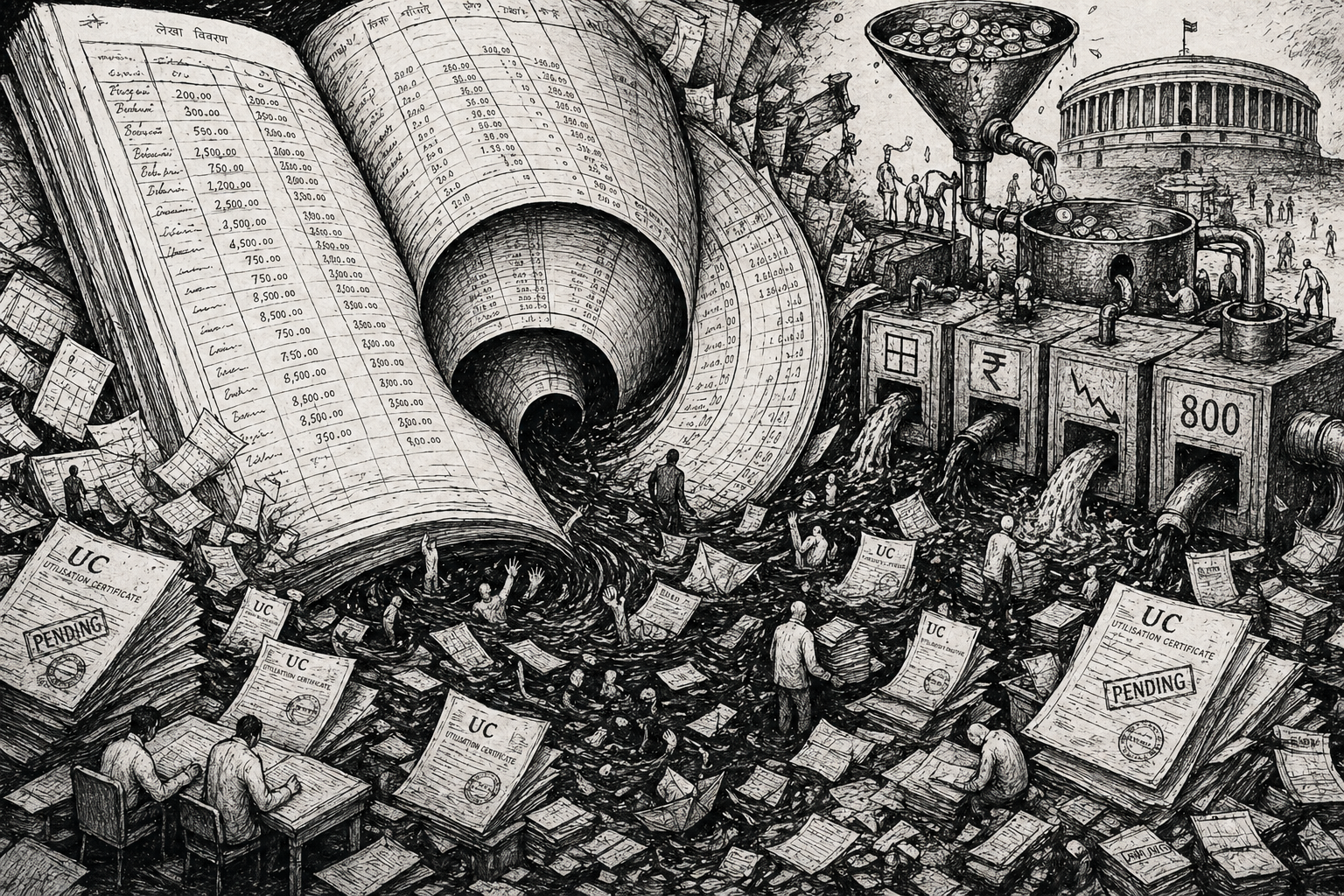
Article 270 of the Constitution, as amended in 2000, excludes cesses and surcharges from the divisible pool shared with states. This is a deliberate design choice, not an accident: it gives the Union the flexibility to raise revenue for specific purposes without an automatic transfer obligation attached. The design becomes a federalism problem only when the excluded categories grow large enough to change how much of the Union's total tax collection actually reaches the states, which is roughly what happened over the last decade and a half.
Figure 1

The non-shareable slice of the Union's tax revenue, selected years. Cesses and surcharges are excluded from the divisible pool under Article 270; the figures here exclude the GST compensation cess, which is accounted for separately below. Source: India Ratings analysis.
The numbers vary by year and methodology, and I want to be honest about the variance rather than pretend a single figure settles the argument. The India Ratings series above shows the share of cesses and surcharges in gross tax revenue nearly doubling from 10.4 per cent in 2011-12 to 19.9 per cent in 2020-21, before falling back to roughly 14.5 per cent by 2023-24 as fuel duties eased. Other estimates that fold the GST compensation cess into the same calculation put the 2021-22 figure closer to 28 per cent. Manish Gupta of the National Institute of Public Finance and Policy, in a 2024 working paper on enhanced devolution and fiscal space at the state level, calculates that the divisible pool has shrunk from close to 90 per cent of gross tax revenue in 2011-12 to 75.7 per cent by 2022-23, and estimates that of the nominal 41 per cent devolution states are owed, roughly 4 percentage points is effectively lost to this mechanism before it reaches a state treasury.
The consequence in rupee terms has been quantified by economists who agree on little else. At a Thiruvananthapuram conclave that brought together Pinaki Chakraborty of NIPFP, Arvind Subramanian, M. Govinda Rao and Jayati Ghosh alongside several southern finance ministers, the widely cited estimate held that states collectively lost Rs 5,26,747 crore to divisible pool shrinkage between 2015-16 and 2018-19 alone. PRS's own tracking shows untied transfers, the money a state can spend according to its own priorities rather than the Union's, falling from 68 per cent of total transfers under the Fourteenth Commission to 64 per cent under the Fifteenth.
The CAG's audit of the Union government's accounts for 2018-19 put a sharper point on where some of this money actually goes. Of Rs 2.75 lakh crore collected across 35 different cesses and levies that year, only Rs 1.64 lakh crore was remitted to the specific reserve funds for which those cesses were legally created; the remainder, close to Rs 1.1 lakh crore, remained in the Consolidated Fund of India. The audit's individual findings are worth naming: Rs 47,272 crore of GST Compensation Cess went unremitted over the scheme's first two years; Rs 1,24,399 crore collected as a crude oil cess between 2010 and 2020 was never transferred to the Oil Industry Development Board it was meant to fund; Rs 10,157 crore of Road and Infrastructure Cess suffered the same fate.
What happens when the compensation runs out
If divisible pool erosion is a slow structural bleed, the end of the GST compensation cess is a scheduled cut, and the schedule has now arrived. When GST subsumed a set of state and central indirect taxes on 1 July 2017, states were guaranteed 14 per cent annual growth in their protected revenue base for five years, funded by a cess on tobacco, automobiles, aerated drinks and coal. That guarantee expired in June 2022. When pandemic-era collections could not cover what states were owed, the Union borrowed roughly Rs 2.69 lakh crore through a special RBI window on states' behalf and extended the cess, purely to service that loan, through 31 March 2026.
That date has now passed. Tobacco and pan masala moved to a new excise and health cess framework from 1 February 2026; most other goods were folded into a simplified two-slab GST structure from 22 September 2025, with a 40 per cent ceiling for demerit goods. The GST Council's Group of Ministers on Compensation Cess, chaired by Pankaj Chaudhary, is reported to have reached a near-consensus on replacing the lapsed levy with two new, narrower cesses, a Health Cess on tobacco and pan masala and a Clean Energy Cess on coal and luxury automobiles, a proposal that reportedly requires constitutional amendment and remained before the Council as of mid-2026, with genuine disagreement over whether the proceeds would enter the divisible pool at all.
The scale of what the Union actually collected against what it actually owed deserves more attention than it has received. Press reporting compiled in September 2025 found the Centre collected roughly Rs 6.1 lakh crore in compensation cess between FY21 and FY25 against a loan of Rs 2.7 lakh crore, a ratio of roughly 2.3 to 1 that had likely widened further by the time the cess formally ended. Revenue Secretary Arvind Srivastava estimated the annual revenue implication of the September 2025 rate rationalisation at Rs 48,000 crore, of which roughly Rs 24,000 crore falls to states, while declining to call the number a revenue loss.
State finance ministers were less circumspect. Kerala's K.N. Balagopal put his state's annual loss from the rate cuts at Rs 8,000 to Rs 10,000 crore, warning in the assembly that the reforms could have the worst impact on Kerala's public finances since independence, and separately claimed the cumulative effect of falling divisible pool share, reduced grants and shrinking borrowing space had cost the state something in the range of Rs 57,000 crore a year, a figure his own UDF successor as finance minister publicly disputed even while sharing the underlying complaint. Tamil Nadu's Thangam Thennarasu pushed for either a constitutional amendment to continue the compensation mechanism or a higher bound rate on sin and luxury goods. Eight opposition-ruled states convened in Delhi on 29 August 2025, warning of revenue losses in the range of 15 to 20 per cent, and left without a resolution.
The states that will feel it first
Not every state enters this squeeze from the same starting position, and treating the five 2026 winners as a single fiscal category obscures more than it reveals.
Figure 2

Outstanding state debt relative to gross state domestic product, 2025-26. Sources: RBI, State Finances: A Study of Budgets 2025-26; NITI Aayog, Macro and Fiscal Landscape of Kerala (2025); West Bengal Budget 2026-27; PRS, Tamil Nadu Budget Analysis 2025-26.
Kerala is the most exposed of the four for which comparable data exists. Its debt sits at roughly 33 per cent of GSDP in the 2025-26 revised estimate, on a trajectory NITI Aayog projects toward 36 to 38 per cent, with a revenue deficit of 1.9 per cent of GSDP and a fiscal deficit target of 3.2 per cent that leaves almost no headroom under the Sixteenth Commission's new 3 per cent annual cap.
Committed expenditure, salaries, pensions, and interest payments that no government can meaningfully cut within a single budget cycle already consume roughly 75 per cent of the state's revenue receipts, per PRS's most recent tracking. Kerala is also, by the RBI's own demographic classification, an ageing state, with a pension and health burden that will only grow. On top of this base, the UDF has added an unpriced Rs 6,000-a-month NYAY transfer and an unpriced pension increase, at the exact moment the one Finance Commission grant category designed to help exactly this kind of state, the revenue-deficit grant, has been discontinued.
West Bengal's debt burden is larger in absolute terms, close to Rs 7.5 lakh crore, with an interest bill of nearly Rs 49,000 crore a year against a debt-to-GSDP ratio around 37 to 38 per cent. Welfare spending, of which Annapurna Bhandar is now the largest single line, accounts for roughly 46 per cent of the state's Rs 1.8 lakh crore social-sector budget within a total expenditure of Rs 4.38 lakh crore, a share high enough that the beneficiary-narrowing exercise described above reads less as fiscal caution and more as the only lever available to a government that has already committed to the transfer politically and cannot afford it universally.
Tamil Nadu is constrained rather than fragile. Its committed expenditure runs to roughly 62 per cent of revenue receipts by the state's own 2025-26 budget documents, a lower ratio than Kerala's, and it sits atop an economy large enough, with 11.2 per cent growth recorded in 2024-25 and a GSDP above Rs 35 lakh crore, to absorb pressure that would break a smaller state. The gap between TVK's campaign promises and what the government has actually delivered on its two costliest commitments, the women's transfer increase and the farm loan waiver, is the clearest early indicator of how a charismatic, first-time governing party handles the difference between a manifesto and a budget.
Assam, by contrast, has room. Its debt-to-GSDP ratio near 24 per cent is comfortably the lowest of the four, and even a multi-fold increase in Orunodoi lands on a fiscal base that can, for now, absorb it without immediately testing the new 3 per cent deficit cap.
The freebie debate has run for thirteen years and settled almost nothing
None of this fiscal pressure exists in a legal vacuum. India has had a live, unresolved constitutional argument about the propriety of election-season cash promises since 2013, when the Supreme Court in S. Subramaniam Balaji v. Government of Tamil Nadu held that manifesto promises do not constitute a corrupt practice under election law, while gently suggesting the Election Commission develop guidelines regardless.
The argument resurfaced with more force in January 2022, when advocate Ashwini Kumar Upadhyay filed a public interest litigation asking the Court to treat parties promising what he called irrational freebies as liable for deregistration, and to compel an economic assessment body the Court ultimately declined to order. The Election Commission's own affidavit, filed in April 2022, took the position it has held consistently since, that the content of a manifesto is a policy matter beyond its remit to regulate. The case has stayed alive since, tagged in early 2026 with a newer petition seeking a mandatory Fiscal Impact Statement for every manifesto commitment, automatic de-recognition for parties that fail to disclose one, and a CAG performance audit of freebie schemes under Article 282. As of the middle of this year, the batch remained pending, without a ruling, through an entire election cycle it was ostensibly meant to inform.
The economic argument underneath the legal one is more interesting than the legal one, and considerably less settled than either side's rhetoric suggests. Jean Drèze and Reetika Khera have spent two decades building the empirical case that India underinvests in social protection and that transfers targeted at nutrition, health, and education produce measurable human capital returns rather than simply financing consumption.
A 2024 survey of health infrastructure they were involved with, across several north Indian states, found Kerala, Tamil Nadu and Himachal Pradesh standing out as places where a poor patient retains something close to a genuine option of decent public healthcare, a finding that complicates any blanket claim that welfare spending crowds out state capacity. Set against that, the RBI's own State Finances reports and the Sixteenth Commission's subsidy chapter draw a narrower line: unconditional cash transfers specifically, as distinct from welfare spending broadly, have grown fast enough that six of the twelve states running them carry revenue deficits, and their design, without exit criteria, income testing or sunset clauses, is what distinguishes them from the health and education spending Drèze and Khera defend.
The distinction that actually holds up, on the evidence both sides marshal, runs between transfers built to develop human capital, which have a defensible research record, and untargeted cash transfers designed primarily to move votes in a single election cycle, which do not carry the same evidentiary support regardless of which party administers them. West Bengal's BJP inheriting and then narrowing the scheme it once denounced does not settle which side of this argument was right. What it demonstrates is that the electoral logic of a well-targeted cash transfer now overrides party ideology almost entirely, and that when a government wants to keep the electoral benefit while controlling the fiscal cost, eligibility rules, not the headline transfer amount, are where the real policy gets made.
What the states actually control
Figure 3

West Bengal's women's cash transfer, before and after the 2026 eligibility reset. Sources: Deccan Herald; West Bengal Budget 2026-27; Goodreturns, 1 July 2026.
The five governments elected in 2026 face constraints that long predate their own decisions: a divisible pool structurally shrunk by a legal mechanism the Constitution itself permits, a compensation cess that has now formally lapsed after collecting more than twice what it was created to repay, and a Finance Commission award that trades a marginally more generous horizontal split for the loss of the one grant category built specifically for states running structural deficits. None of these three facts was decided by the voters of Kerala, Tamil Nadu, West Bengal, Assam or Puducherry, and none will be undone by anything those state governments do in the next five years.
What each government controls is the design of its promises, and the four approaches already on display diverge in instructive ways. Kerala has made the largest unpriced promise onto the tightest fiscal base of the group, and the arithmetic of NYAY remains, as of this writing, entirely unpublished. West Bengal has resolved its own arithmetic by shrinking the pool of people entitled to the money, using income, employment and now citizenship status as the sorting mechanism, a solution that keeps the budget line credible at the cost of turning a universal welfare scheme into a screened one. Tamil Nadu has delivered a fraction of what it promised on its costliest commitment while leaving its headline transfer increase unimplemented eight months into government. Assam alone entered this cycle with genuine fiscal room to make good on its promise without immediately testing the Sixteenth Commission's new deficit cap.
Further Reading
On fiscal federalism and the divisible pool: Reading the Centre's Books · What India Promised the Planet · Report of the 16th Finance Commission for 2026-31, PRS Legislative Research
On welfare design and electoral rolls: Eleven Years, Six Asks · The Cash and the Category · Tamil Nadu's Welfare Gamble
On the freebie debate: Ashwini Kumar Upadhyay v. Union of India, Supreme Court PIL tracker, The Tribune · Jean Drèze and Reetika Khera, Recent Social Security Initiatives in India, World Development, 2017
This article flags two figures that still need primary-source verification before republication elsewhere: the exact CAG report number for the FY2018-19 cess-retention finding, and the precise terms on which the GST Council's Group of Ministers eventually settles the Health and Clean Energy Cess proposal, which was still under negotiation at the time of writing.
Varna is a development economist and writes at policygrounds.press.
















Write a comment ...