
Three decades of randomised evidence from India's panchayats tell us what women in office actually do. On April 17, 2026, the Lok Sabha defeated a bill that used women's reservation as its label while carrying delimitation and parliamentary expansion that had little to do with women's reservation. The defeat was the win. The work ahead is to operationalise the 2023 Act on honest terms.
On April 17, 2026, I watched the Constitution (One Hundred and Thirty-First Amendment) Bill fall on the floor of the Lok Sabha from a laptop in my own study, 298 members voted in favour. Two hundred and thirty voted against. Five hundred and twenty-eight were present. A constitutional amendment under Article 368 requires a majority of the total membership of the House and two-thirds of those present and voting. The two-thirds threshold was 352. The bill was fifty-four votes short. I remember the exact second when the Speaker read out the numbers, and the slow release of breath that followed. Women's reservation remained the law of the land. What had fallen was a bill that used women's reservations as its cover story.
The Nari Shakti Vandan Adhiniyam, the 106th Constitutional Amendment Act of 2023, is already law. The Congress voted for it, as did almost every party in the Lok Sabha, with the two AIMIM members dissenting on the ground that the bill carried no separate reservation for Muslim women or for women of Other Backwards Classes.
The question on April 17 was not the merit of women's reservation. The question was whether India's ruling party would be permitted to use an Act already passed as the vehicle for something else, and to push that something else through on a 2011 Census, ahead of the caste enumeration now underway, with a parliamentary expansion that shifts power decisively northward and weakens the Rajya Sabha's constitutional weight in the bargain. The opposition said no.
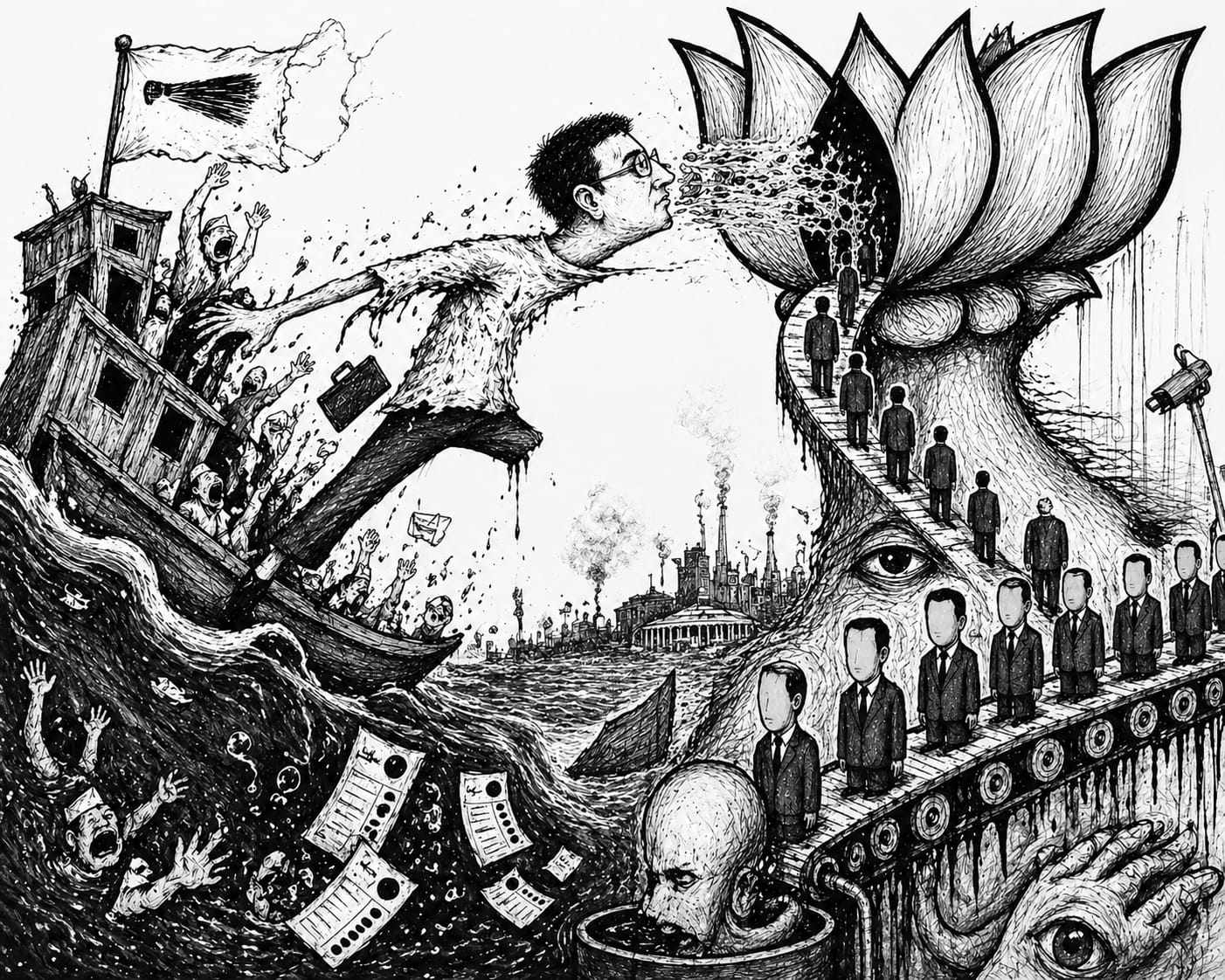
This essay is about women's representation and reservation in India's Parliament and state legislatures, about the delimitation and parliamentary expansion the BJP tried to smuggle through under its banner, and about three decades of development economics research on what happens when women hold political office.
The literature is unusually clean by the standards of Indian policy research, because panchayat reservation under the 73rd Amendment of 1993 was implemented through a rotation rule that approximates random assignment. Raghabendra Chattopadhyay and Esther Duflo, Lori Beaman, Rohini Pande and Petia Topalova, Lakshmi Iyer, Anandi Mani and Prachi Mishra, Irma Clots-Figueras, Sonia Bhalotra, and Rikhil Bhavnani, among others, have produced one of the largest bodies of causal evidence on political quotas in development economics.
That literature tells us women in office govern differently on the dimensions where women's interests diverge from men's. It also tells us, with particular clarity in the state-level evidence, that the design of a quota shapes which women enter, and which women enter shapes whether the outcomes the literature predicts appear at all. A reservation operationalised on a constituency map that redistributes power away from the states that have built the material conditions for women's political agency and pre-empts the caste data needed to extend reservation intersectionally will not produce those outcomes. The defeat of the 131st Amendment Bill preserves the space to operationalise the 2023 Act on a different basis. That is the task te opposition has to carry out.
The Act in force, the bill that tried to rewrite it, and the April 17 vote
The Nari Shakti Vandan Adhiniyam, enacted as the 106th Constitutional Amendment Act, was introduced in the new Parliament building on September 19, 2023, as the Constitution (128th Amendment) Bill. The Lok Sabha passed it on September 20 by 454 votes to 2, with only the AIMIM dissenting. The Rajya Sabha passed it unanimously the next day, 214 to zero. The Act inserts Articles 330A, 332A, and 334A into the Constitution and amends Article 239AA to bring the Delhi assembly within its scope. It reserves one-third of seats in the Lok Sabha, the state legislative assemblies, and the Delhi assembly for women, with one-third of the seats already reserved for Scheduled Castes and Scheduled Tribes, further reserved for women within those categories. The reservation carries a fifteen-year sunset clause, extendable by Parliament. Seats reserved for women rotate after each delimitation exercise. The Rajya Sabha and the state legislative councils are excluded.
The Act has one provision that matters more than all the others combined. Article 334A(1) states that the reservation shall come into effect after the first Census taken after the Act's commencement, and only after the delimitation exercise based on that Census. Census 2027 Phase 1 commenced on April 1, 2026. The Population Enumeration is scheduled for February 2027, with a reference date of March 1, 2027. Publication, a Delimitation Commission, hearings and objections, and final orders will take at least another eighteen months thereafter. Under the Act's own terms, women's reservation cannot apply to the 2029 general election. This was the flaw the Congress pointed out when the Act was passed.
Rahul Gandhi, on the floor in September 2023, called for immediate implementation and for OBC reservation within the bill. Neither was accepted. The BJP's framing at the time was that tying operationalisation to delimitation was a procedural necessity. What the 131st Amendment Bill, tabled on April 16, 2026, by Law Minister Arjun Ram Meghwal, revealed was that the delimitation linkage had been political from the start.
The 131st Amendment Bill came bundled with two companion bills: the Delimitation Bill, 2026, and the Union Territories Laws (Amendment) Bill, 2026, which Home Minister Amit Shah had introduced the same day. Together, they did four things. The 131st Amendment Bill would have increased the maximum size of the Lok Sabha from 550 to 850 members. It would have reverted to proportional population-based seat allocation. It would have stripped Article 334A of its post-commencement Census precondition, and it would have empowered Parliament to decide by simple majority which Census would serve as the basis for delimitation.
The Delimitation Bill, 2026 specified "the latest published census as on the date of the constitution of the Delimitation Commission." Since the Census 2027 data will not be published in time, it means the 2011 Census. The government's rhetorical frame was that it wanted to bring women's reservation forward, ahead of the 2027 timeline, so it could apply to the 2029 general election. The technical effect went the other way. The bill would have imposed a constituency map built from fifteen-year-old demographic data, redistributed roughly twenty-seven seats away from the south and toward the north, changed the ratio of Lok Sabha to Rajya Sabha seats from 2.2:1 to 3.3:1, which weakens the Rajya Sabha in joint sittings and in electoral college calculations, and raised the ceiling on the Council of Ministers under Article 75 from 81 to 122.
None of these was necessary to operationalise women's reservation. All of them were smuggled inside the label.
The opposition held. Mallikarjun Kharge had convened the India bloc leaders on April 15 to coordinate rejection. Priyanka Gandhi Vadra and Rahul Gandhi both took the floor on April 17, and the case they made against the bill was that it was a delimitation exercise with a women's reservation label attached. Rahul Gandhi called what the government was doing "nothing short of an anti-national act." The bill, he said, was "a bypass of the caste census. Here, they are trying to avoid giving power and representation to my OBC brothers and sisters and taking power from them." The DMK held on to the specific ground of the southern states' seat loss. The TMC held on to the bill's OBC and Muslim women's absence, as did the Samajwadi Party and the RJD. Dharmendra Yadav of the Samajwadi Party pressed publicly for Muslim women's reservation, sharpening a line his party had only gestured at in 2023. The INDIA bloc's internal negotiation on the caste census had travelled further than the BJP had expected.
The vote came in the evening. The numbers appeared on the board. 298 ayes. 230 noes. Two-thirds of 528 is 352. After the tally, the government withdrew the Delimitation Bill and the Union Territories Laws Bill, describing them as intrinsically linked to the 131st. The House was adjourned sine die the following day.
This is the first constitutional amendment bill the Modi government has introduced and lost. The supermajority requirement under Article 368 is the constitutional protection that prevents a government with a simple majority in the lower house from rewriting the compact between the states and the Union, or between the two houses of Parliament, without substantial cross-party consent. On April 17, that protection worked. The Nari Shakti Vandan Adhiniyam stands, unamended, as it did before the bill was introduced. Its internal postponement clause remains. What now needs to be asked is how the Act is operationalised in terms that reflect what women's reservation was meant to do in the first place.
Three decades of panchayat evidence, and what it establishes
India has three decades of data on what happens when women hold office, because the 73rd Amendment of 1993 introduced reservation for women in panchayat presidencies through a rotation rule that approximates random assignment. Raghabendra Chattopadhyay and Esther Duflo's 2004 Econometrica paper, the foundational study in this literature, used data from 265 Gram Panchayats in Birbhum district of West Bengal and Udaipur district of Rajasthan.
Their finding was specific and durable: women leaders invest more in drinking water and roads in West Bengal, and in drinking water in Rajasthan. The divergence tracked systematic differences in the priorities women and men raised in Gram Sabha meetings. In West Bengal villages with women pradhans, women were twice as likely to have addressed a request to the pradhan in the previous six months. Political communication is gendered, and the leader's identity changes who speaks and what gets built.
Lori Beaman, Chattopadhyay, Duflo, Rohini Pande, and Petia Topalova, in a 2009 paper in the Quarterly Journal of Economics, extended this to attitudes. Villagers who had a woman pradhan evaluated identical policy positions no less favourably than when those positions were taken by a man, after two terms of exposure. Implicit Association Tests showed that men's unconscious associations of leadership with maleness weakened only after repeated exposure.
The same team's 2012 Science paper, built on 8,453 surveys of adolescents and their parents across 495 villages, found that in villages reserved for women over two election cycles, the gender gap in parents' aspirations for their children closed by 20 percent, the gap in adolescents' own aspirations closed by 32 percent, and the gender gap in adolescent educational attainment disappeared. None of these outcomes showed up after a single reserved cycle. The shift happened through accumulated exposure, not through legal change alone.
Lakshmi Iyer, Anandi Mani, Prachi Mishra, and Topalova, in a 2012 paper in the American Economic Journal: Applied Economics, showed that mandated female representation in local government produced a large and statistically significant increase in documented crimes against women. Their careful finding, often misread in the Indian press, was that the increase was almost entirely due to reporting rather than to incidence. A similar pattern held for crimes targeting Scheduled Castes under caste reservation. In their reading, political representation is a channel through which disadvantaged groups gain access to the criminal justice system.
At the state legislative level, the evidence base is thinner but consistent. Irma Clots-Figueras, in a 2011 paper in the Journal of Public Economics using close elections across the sixteen largest states from 1967 to 2001, found that women legislators elected from Scheduled Caste and Scheduled Tribe reserved seats invested more in health and early education, supported amendments to the Hindu Succession Act that equalised women's and men's inheritance rights, and favoured redistributive measures including land reform.
Women legislators from upper-caste backgrounds in general seats showed no such effects, and on some dimensions, reduced social expenditure. Sonia Bhalotra and Clots-Figueras, in the 2014 American Economic Journal: Economic Policy, found that a 10-percentage-point increase in women's state assembly representation produced a 2.1-percentage-point reduction in neonatal mortality in the districts those women represented.
Thushyanthan Baskaran, Bhalotra, Brian Min, and Yogesh Uppal, in a 2024 Journal of Economic Growth paper using night-light intensity as a proxy for constituency-level economic activity across state assemblies from 1992 to 2012, found that constituencies electing women experience significantly higher growth, with no evidence of negative spillovers.
The evidence base here is uncontested. It is one of the cleanest in the field of Indian development economics. Women representatives govern differently on the dimensions where women's interests diverge from men's. They reduce corruption, improve child survival, and raise girls' aspirations and attainment, though this last effect requires time and repeated exposure. Clots-Figueras's finding that SC and ST women legislators drive the legislative redistribution is the central result of the state-level literature. The women who redistribute, who legislate on inheritance, and who invest in health are the women from socially disadvantaged backgrounds. This is the ground on which the case for an OBC sub-quota within the 106th Amendment rests empirically, not merely politically.
What the panchayat evidence does not tell us about the legislative quota
Panchayat literature provides evidence of what women do once they hold office. The legislative reservation of the 106th Amendment poses a different question: who enters, through whose permission, at what cost, and with what durability. Here, the evidence is thinner, and what there is suggests that legislative quotas in a party-gated system behave differently from panchayat quotas in a community-gated system.
Rikhil Bhavnani, in a 2009 American Political Science Review paper that exploited Mumbai's municipal rotation, found that the probability of a woman winning a previously reserved ward once reservation was withdrawn was approximately five times higher than in wards that had never been reserved. Beaman and colleagues found a similar persistence in West Bengal. The mechanism, in both cases, was that incumbent women ran again, and voters who had experienced women's leadership updated their priors.
The state legislative record looks different. Sonia Bhalotra, Clots-Figueras, and Lakshmi Iyer's 2018 Economic Journal paper examined close elections in Indian state assemblies from 1980 to 2007. Over that period, women were 5.5 per cent of election winners and 4.4 per cent of candidates. The authors used a close-election regression discontinuity design to ask whether a woman's victory in a previous election increased women's candidacy in the next election. The answer was yes, but the mechanism differed from the panchayat case. The increase came almost entirely from the winning woman contesting again rather than from new women entering the candidate pool. There was no significant entry of new female candidates, no change in male or female voter turnout, and no spillover to neighbouring constituencies. In plain terms, panchayat reservation widens the pipeline. Legislative electoral success thickens the incumbency path for the woman who already made it, and leaves the barrier to entry intact for the next.

Panel A: Bhavnani 2009, APSR 103(1), on Mumbai municipal ward rotation. Panel B: Bhalotra, Clots-Figueras and Iyer 2018, Economic Journal 128(613), on close-election regression discontinuity in Indian state assemblies 1980-2007. Panel B heights are schematic; they show the direction and decomposition of the estimated effect, not the specific magnitudes of the coefficients.
Panchayat reservation widened the pool of women entering politics. The probability of a woman winning a previously reserved ward, after the reservation was withdrawn, was about five times higher than in wards that had never been reserved. Legislative reservation does not do that. When a woman wins a state assembly seat, she tends to stand again, but there is no measurable increase in the number of new women entering the candidate pool behind her. In states with entrenched gender bias, the new-entry effect turns negative. The rotation rule recycles the same small pool of politically connected women rather than widening the entry gate. This is why the panchayat evidence cannot be read across directly to the Lok Sabha and state assemblies.
The reasons for this divergence are visible in the mechanics of candidate selection. Panchayat candidates are drawn from a village population; the barrier to entry is social. Lok Sabha and state assembly candidates are selected by political parties, with ticket distribution shaped by winnability arithmetic, resource endowments, caste arithmetic, and, in India's upper-level politics, most visibly, by family connections.
Analysis of the 18th Lok Sabha suggests that over half of the sitting women MPs have political family links. This is the bibi-beti-bahu pipeline through which Indian political parties of every ideological location have routed women into national and state legislatures. Congress is not exempt from this observation. The pipeline is not a failure in itself, because women who enter through family networks sometimes build independent political bases. But the pipeline does not, on its own, widen the pool of entry for women without those connections.
The state legislative evidence indicates that a rotation rule imposed on the current selection system will rotate the dynasties, and that this rotation will be consequential for the dynasties that lose access to a seat in a given cycle. It will not produce the class and caste composition of candidates that the panchayat evidence on substantive representation points toward.
The existing representation data tells the same story from the other direction. The 18th Lok Sabha was the first parliamentary election after the Nari Shakti Vandan Adhiniyam was enacted, and it returned fewer women than the 17th. Seventy-four women won out of approximately 800 women candidates and 8,360 candidates overall. The BJP elected 31 women, the Congress 13, the TMC 11 of 29 (38 per cent of its parliamentary party), the Samajwadi Party 5, and the DMK 3. In state assemblies, women hold an average of 9 per cent of seats. Uttar Pradesh has 47 women MLAs, West Bengal 40, Bihar 29, and Madhya Pradesh 27. Kerala, which has some of the strongest development indicators for women among Indian states, returned zero women to the 18th Lok Sabha.
These numbers are a measure of the selection problem, not of a supply problem. Women who have built the political capital to run are routinely denied tickets, and women who do get tickets are routinely fielded in seats the party does not expect to win. A constituency rotation rule, taken together with the family pipeline, will change the names on the list without altering the class and caste texture of the women it produces.
This observation is where the opposition's position has to sharpen, and where I think it is beginning to do so. A reservation that takes seriously the outcomes documented in panchayat literature has to widen entry, and widening entry requires more than rotation. It requires OBC sub-quotas, so the intersectional disadvantage documented by the Bihar caste survey is not reproduced within the women's quota. It requires transparency in the distribution of party tickets. It requires state funding of women candidates, so entry does not depend on family wealth. It requires, eventually, political reservation for OBCs as a category, which would give the OBC sub-quota within women's reservation the constitutional anchor it currently lacks.
The counterfactual arithmetic, and what the bill's design would have cost
The development economics literature permits a specific counterfactual calculation of the Act's increase in representation and of what the 131st Amendment Bill's design would have done to that potential. The arithmetic needs heavy caveats, which I state up front rather than bury at the end.
The starting point is Bhalotra and Clots-Figueras's 2014 American Economic Journal: Economic Policy paper. Using close elections in Indian state assemblies and data from the District Level Household Survey, they estimate that a 10-percentage-point increase in women's representation in a state legislature produces a 2.1-percentage-point reduction in neonatal mortality in the districts those women represent. The mechanism they trace is that women legislators invest more in public antenatal services, promote institutional delivery, and expand routine immunisation. Their estimation sample had baseline neonatal mortality at roughly five to eight per cent of births, which means the 2.1 point reduction corresponded to a relative reduction of approximately thirty-five per cent per ten points of added representation.
The Nari Shakti Vandan Adhiniyam increases women's share of the Lok Sabha from the current 13.6 per cent in the 18th Lok Sabha and of state assemblies from an average of around 9 per cent toward the one-third floor the Act mandates. The increase in representation is roughly 20 percentage points. Applied as a linear absolute coefficient, the Bhalotra-Clots-Figueras estimate would imply a 4.2-percentage-point reduction in neonatal mortality. India's current NMR, per the Sample Registration System 2021, is 19 per 1,000 live births, or 1.9 per cent. A 4.2 percentage point reduction on a 1.9 per cent baseline would fall below the zero floor. Linear extrapolation breaks immediately against that floor, which is the first important limit on what the arithmetic can deliver.
The estimate can instead be scaled as a relative effect under explicit assumptions. Three scenarios bracket the range. In a conservative scenario, assume the effect is one-quarter of the original coefficient's proportional size. This allows for the difference between state assemblies as estimated and the Lok Sabha as it would operate, for baseline-mortality decline reducing remaining slack, and for the state-legislative candidate-emergence evidence showing that rotation does not deliver women of the composition the Clots-Figueras 2011 finding implicates. NMR falls from 19 to roughly 15.7. Applied to India's approximately 25.5 million annual live births, the annual savings amount to on the order of 85,000 averted neonatal deaths. In a moderate scenario, assuming half the proportional effect, NMR falls to roughly 12.4, and the annual figure is approximately 170,000. In the upper-bound scenario, taking the proportional coefficient at face value, NMR falls to roughly 5.7, and the annual figure reaches approximately 340,000.

Back-of-the-envelope; not a structural estimate. Applies the Bhalotra and Clots-Figueras (2014) coefficient to the Act's roughly 20-percentage-point increase in representation, under three assumptions about how the coefficient scales. Panel A shows baseline NMR per state from SRS 2021 with seat reallocation under 2011-Census delimitation annotated. Panel B shows the three scenarios.
The bill would have shifted seats from states where few babies die in their first month (Kerala 4 per 1,000 live births, Tamil Nadu 9) to states where many still do (Uttar Pradesh 29, Madhya Pradesh 31). At first, that looks like it should help, because those are the states with the most room to improve. The published evidence says otherwise: the health gains from women legislators come almost entirely from women elected on SC and ST reserved seats. Without an OBC sub-quota, the reservation allocates the new seats to women whose social composition does not match that identified by the evidence. Panel B translates the twenty-point increase in representation into averted child deaths per year under three assumptions about the mechanism's strength. The conservative scenario gives around 85,000 averted deaths per year. The moderate gives 170,000. The upper bound gives 340,000. All three are large. The range reflects the degree to which the mechanism is assumed to hold under a reservation regime.
The caveats are not ornamental. The Bhalotra-Clots-Figueras coefficient is identified in state assembly close elections, not Lok Sabha representation and not under a reservation regime. The estimation sample had much higher baseline mortality than India does today, leaving more slack for public antenatal investment to operate.
The effect is not distributed uniformly among women legislators: Clots-Figueras 2011 shows that the redistributive and health-investing behaviour is concentrated among women elected from Scheduled Caste and Scheduled Tribe reserved seats, with no equivalent pattern among upper-caste women in general seats. Diminishing returns at low baseline mortality are real, and the Act's rotation rule does not guarantee the composition of women the Clots-Figueras effect requires. What the arithmetic establishes, subject to all of this, is an order of magnitude. Even the conservative scenario is in the tens of thousands of averted neonatal deaths per year. The moderate scenario is in the hundreds of thousands. The operational question of women's reservation carries a material weight that political commentary routinely elides.
The 131st Amendment Bill would have changed the geography of this arithmetic in one specific direction. The bill's seat redistribution under a 2011 Census-based delimitation would have increased the parliamentary weight of states with the highest baseline NMR (Uttar Pradesh at 29 per 1,000, Madhya Pradesh at 31) and reduced the weight of states with the lowest (Kerala at 4, Tamil Nadu at 9). The naive reading is that redistributing seats toward high-mortality states raises the headroom for averted deaths, because those are the states with the most slack to close. That reading mistakes the mechanism. The Clots-Figueras finding establishes that the redistributive effect operates through the legislative behaviour of women from Scheduled Caste and Scheduled Tribe backgrounds.
A reservation operationalised without an OBC sub-quota, on a constituency map that shifts seats toward states where the women's political pipeline is most heavily filtered by dynasty, caste, and party practice, would deliver women whose composition does not match the identification sample. The headroom widens, but the mechanism to close it is not delivered, and the potential remains unrealised.
The parallel exercise on Baskaran, Bhalotra, Min and Uppal's 2024 Journal of Economic Growth paper runs in the same direction. Their close-election regression discontinuity on 4,265 state assembly constituencies from 1992 to 2012 finds that constituencies electing women with small margins record night-light growth over an electoral term that is 15.25 percentage points higher than in constituencies electing men.
The authors themselves caution that the result is limited to a narrow set of close-mixed-gender races and does not generalise to other constituencies. Under the reservation, which operates by rotation rather than close electoral competition, the effect would likely be smaller. The direction, however, is visible in the same pattern: higher constituency-level growth, lower corruption, and reduced criminality among elected representatives.
These are back-of-the-envelope calculations, not structural estimates. What they show is that the potential pay-off from operationalising the Act is large, that it depends on which women the reservation delivers, and that the 131st Amendment Bill's design choices (operation under 2011 Census delimitation, no OBC sub-quota, northward seat redistribution) would have severed the link between the representation increase and the mechanism the published evidence identifies. The Congress position on decoupling operationalisation from fresh delimitation and on adding an OBC sub-quota rests on more than political preference. The development economics literature implies that both moves are necessary conditions for the reservation to produce the outcomes it is justified on.
The women the Act omits, and the caste data the bill would have bypassed
The Act reserves seats for women within the existing Scheduled Caste and Scheduled Tribe quotas. It carries no sub-reservation for women of Other Backward Classes, and none for religious minorities. The 131st Amendment Bill did not address either absence. Its design would have made both absences harder to remedy. This is the point on which Priyanka Gandhi's and Rahul Gandhi's April 17 interventions sharpened into a coordinated opposition position, and the point on which the INDIA bloc held.
The 2023 Bihar caste-based survey, released on October 2 of that year, enumerated 130.7 million people and produced the first comprehensive state-level caste data in India in nearly a century. Backward Classes and Extremely Backward Classes together accounted for 63.14 per cent of Bihar's population, Scheduled Castes for 19.65 per cent, Scheduled Tribes for 1.68 per cent, and the unreserved general category for 15.52 per cent.
The Rohini Commission, constituted in October 2017 to examine sub-categorisation of the central OBC list, submitted its report on July 31, 2023. That report found that 97 per cent of central OBC reservation benefits had gone to 25 per cent of sub-castes, and that 983 OBC communities, roughly 37 per cent of the central list, received zero representation in the Commission's analysis of central government jobs and admissions. The Rohini Commission report remains in cold storage. The government has not released it, tabled it, or acted on its findings.
The Census 2027 caste enumeration, approved by the Cabinet Committee on Political Affairs on April 30, 2025, under pressure of Congress's 2024 election campaign, will produce the first national caste data comparable to the Bihar findings since 1931. It will make an OBC sub-quota within women's reservation not merely possible but politically difficult to refuse.
The 131st Amendment Bill was structured to prevent precisely that outcome. By tying delimitation to the 2011 Census, by empowering Parliament to set the Census for delimitation by simple-majority law, and by removing the Article 334A precondition that linked women's reservation to the first post-Act Census, the bill would have fixed the constituency map and begun the reservation rollout before the 2027 caste data became available. An OBC sub-quota could technically be added later.
But the political reality of constitutional amendments is that once a compact is struck, reopening it is substantially harder than getting it right the first time. Jairam Ramesh, on April 12, accused the government of wanting to "put the caste census in cold storage." He was describing the operational effect of the bill's Census clause. The INDIA bloc's refusal to let that happen held the line, so that the caste data, when it comes, can be used for the purpose it was demanded.
The Muslim women's absence is a connected problem. Of the 74 women in the 18th Lok Sabha, two are Muslim. They are Iqra Hasan Choudhary of the Samajwadi Party from Kairana in Uttar Pradesh, and Sajda Ahmed of the TMC from Uluberia in West Bengal. Two Muslim women MPs, in a country where Muslims are roughly 14 per cent of the population. The Constitution does not currently permit reservations based on religious identity in legislatures, and the constitutional challenges to any such reservation are substantial. But the structural reality the Act does not name is that the ticket distribution practices through which Muslim women are filtered out at the party stage are unaffected by a rotation rule applied to the general-seat pool.
The Samajwadi Party's April 17 intervention was a political signal. The signal, and the reason it is worth attending to, is that the social coalition that could hold together a serious reform of how women enter politics in India has to include the representation of women from communities who have been kept out of the general pool by a combination of caste, class, religion, and party practice. The Congress position, as Priyanka Gandhi articulated it, is that the 2023 Act should be brought into force now within the existing 543 seats, that the caste census data should be used to add the OBC sub-quota, and that delimitation should be a separate federal negotiation on its own timeline. This is the position the opposition held on April 17, and it is the position the BJP's bill was designed to make procedurally impossible.
What a 2011 Census expansion would have redistributed
The second thing the 131st Amendment Bill smuggled under the women's reservation label was geographic. The panchayat evidence tells us women in office invest differently in child health, schooling, and infrastructure. The states that have built the strongest conditions for women's development over three decades, through a combination of quota, welfare design, and independent political mobilisation, are Tamil Nadu, Kerala, Andhra Pradesh, Karnataka, and, to a lesser extent, Telangana and Maharashtra. The 131st Amendment Bill's delimitation arithmetic would have reduced the parliamentary weight of all of them.
The PRS analysis of a 2011 Census-based delimitation, with the current total of 543 seats, shows Tamil Nadu losing 7 seats, from 39 to 32. Kerala loses five, from 20 to 15. The combined Andhra Pradesh-Telangana unit loses four. Karnataka loses one. Uttar Pradesh gains nine, from 80 to 89. Bihar gains six. Rajasthan gains five. Madhya Pradesh gains three. Under the proposed expansion to roughly 815 seats, the absolute gap widens: Uttar Pradesh rises to 133 seats, Bihar to 69, Tamil Nadu to 48, and Kerala to 22. Karnataka Chief Minister Siddaramaiah's own calculations, circulated in the days before the vote, estimated that five southern states would gain roughly 64 seats under the expansion formula, while seven BJP-dominated northern and western states would gain roughly 130 seats.

Every state gains seats under the bill's expansion in absolute numbers. The chart shows where the gains are concentrated. Southern states gain a handful of seats; northern and central states gain many more. Tamil Nadu's share of the Lok Sabha falls from 7.2 per cent to 5.9 per cent. Kerala's falls from 3.7 to 2.7. Uttar Pradesh's share rises from 14.7 to 16.3. Parliamentary arithmetic turns on share rather than absolute count. The net change is what matters, even when every state on the chart appears to gain.
The demographic argument for this redistribution is real. The South reached below-replacement fertility two decades ago. Tamil Nadu's total fertility rate is 1.8. Kerala's is 1.8. Bihar's is 3.0. A pure population-based seat allocation mechanically penalises the states that control population growth. This is exactly why the 42nd Constitutional Amendment of 1976 froze seat allocation at 1971 Census levels, and why the 84th Amendment of 2001 extended that freeze until the first Census published after 2026. The 84th Amendment's Statement of Objects and Reasons described the freeze as a motivational measure for population stabilisation. The states that took that motivation seriously are the states the BJP's bill would have penalised.
The states that took it seriously are also the states that invested in women. The most recent UNDP and ICRIER analysis of female labour force participation finds that Kerala has the lowest gender gap in LFPR among Indian states, with Andhra Pradesh second. Goa, with its own specific economic profile, has the highest share of women in regular salaried employment. Kerala, Tamil Nadu, and Andhra Pradesh together built the public health, schooling, and welfare infrastructure that has translated into the female literacy, workforce participation, and political agency indicators that the rest of India has not matched.
As I argued in my piece on Tamil Nadu's welfare gamble, the Dravidian welfare model built a structural basis for women's economic agency that newer cash transfer schemes can supplement but cannot substitute for. The 2022-23 PLFS data, as analysed by Ravi and Kapoor in their EAC-PM working paper, shows rural female LFPR in Bihar rising from 3.9 per cent in 2017-18 to 23.3 per cent in 2022-23, and in Nagaland from 15.7 to 71.1 per cent. These are real improvements. But the baseline from which they rise is low, the character of that work is overwhelmingly informal, and the institutional setup that distinguishes salaried from marginal employment has not been built in the north at anything like the scale it has in the south.
The BJP's bill would have shifted political weight away from the states whose women have the strongest material ground to stand on, toward the states where women's political emergence is most heavily filtered by dynasty, agrarian arrangements, and the social conservatism of caste politics. A woman's reservation operationalised on that map would generate women legislators. It would not, on the evidence, generate the redistributive, developmental, child-health-improving legislative behaviour that the state-level literature associates with women from socially disadvantaged backgrounds. The shape of the bill served its purpose precisely.
As I argued in my piece on India's fiscal centralisation, the pattern of constraining the states that generate disproportionate national revenue while redistributing political power toward the states that do not has been consistent across budgetary and constitutional instruments under this government. The 131st Amendment Bill fits inside that pattern. Its defeat interrupts it, for now.
Six reforms the Congress and the INDIA bloc have to push
The defeat of the 131st Amendment Bill preserves a window. The 106th Amendment stands. The Census 2027 is underway and will produce caste data for the first time since 1931. The delimitation exercise, freed from the bad-faith bundle the BJP tried to attach to women's reservation, is open to being renegotiated. The work the opposition has to do, in the months before the 2029 election cycle opens, is to push six linked reforms.
The first is to decouple the operationalisation of women's reservation entirely from delimitation. Former Chief Election Commissioner S.Y. Quraishi has argued that nothing in the constitutional structure actually requires a fresh delimitation exercise as a precondition. Seats can be reserved by rotation within the existing 543 constituencies, using the 1971-derived map currently in force. The 2029 general election can be fought under the reservation. The delimitation question, with all its federal consequences, is a separate negotiation on its own timeline. The Congress position, which I support, is that the linkage in Article 334A was a political choice at the time of the 106th Amendment and can be corrected by a fresh amendment that removes the linkage without attaching any of the Lok Sabha expansion or 2011 Census provisions that the BJP tried to attach on April 16.
The second is to release the Rohini Commission report immediately. There is no legal impediment. The report has been sitting with the Union government since July 2023. It contains the empirical basis for the sub-categorisation of the central OBC list. The 2027 caste enumeration, once published, will extend its data universe. Together, the two provide the factual foundation for an OBC sub-quota within the 106th Amendment's women's reservation.
The third is to add that OBC sub-quota, through a fresh constitutional amendment, on the pattern already established for the SC and ST quotas within the Act. The empirical case is the Clots-Figueras finding on SC and ST women's legislative behaviour, extrapolated to OBC women based on the intersectional disadvantage documented in the Bihar survey. The political case is that the Act, without an OBC sub-quota, will reproduce at the women's tier the structural dominance of upper-caste women that the existing general-category reservation has not dislodged.
The fourth is to extend political reservation to OBCs as a category in Parliament and the state assemblies. This is the constitutional anchor that an OBC sub-quota within women's reservation needs in order to rest on stable legal ground. India currently reserves parliamentary seats for Scheduled Castes and Scheduled Tribes, not for Other Backward Classes. The Congress Working Committee has indicated support for this direction at various points since 2023. The 2027 caste data will make the statistical case.
The political case is the same one the Bihar survey made visible at the state level: that a population majority representing 63 per cent of the country in the most recent comprehensive state survey cannot, in a democratic system, be excluded from the political reservation framework that applies to much smaller demographic categories. The Samajwadi Party, the RJD, the DMK, and the TMC have all indicated willingness to move on this. The INDIA bloc's internal negotiation has advanced further than the BJP expected. It is what kept the floor together on April 17.
The fifth is to reform party ticket distribution practice. This reform does not require a constitutional amendment. It requires internal party decisions on how candidates are selected, how tickets are allocated between winnable and unwinnable seats, and how women candidates' campaigns are financed. The Association for Democratic Reforms has documented that women MPs and MLAs, on average, hold assets and face criminal cases at rates comparable to those of men, suggesting that women who currently make it through the selection filter already share many of the attributes that define entry for men. Widening the entry requires rebuilding the filter itself. This is a reform that the Congress (and other opposition parties) can act on in its own candidate selection practices for 2029, ahead of operationalisation of the Act, and it would be credible evidence of seriousness.
The sixth is to extend the reservation framework to the Rajya Sabha and the state legislative councils, which the 106th Amendment expressly excludes. The councils are less central to legislative business than the directly elected houses, but their exclusion signals that the reservation is understood by the Act's architects as a concession at the lower tier rather than a principle across the legislative structure. An equal-representation principle would apply across.
These six reforms form a programme that the opposition bloc can carry into 2029. The positions have already been staked out in fragments across the last three years, in Rahul Gandhi's 2023 floor speech, in the Congress Working Committee's October 2023 resolutions, in Priyanka Gandhi's April 17 intervention, and in the INDIA bloc's joint statements over the past week. What remains is the assembly. What April 17 did was buy the space to do the assembly. What happens in that space is a political question. It depends on the INDIA bloc continuing to hold together on the caste census and on delimitation as separate and substantive negotiations, rather than packaged inside bills that wear the costume of women's empowerment.
A vote, a reprieve, and the work ahead
The bill fell fifty-four votes short. That is the number on the screen. The meaning is that the opposition refused to let this government use the Nari Shakti Vandan Adhiniyam as the vehicle for a constitutional compact it could not have passed on its own terms. The supermajority requirement under Article 368 is the protection the Constitution gives to the compact between the states and the Union, and to the compact between the two houses of Parliament. That protection worked on April 17. The Act of 2023 stands. Census 2027 is underway. The caste data will come. The delimitation exercise will have to be negotiated, and my party and its allies are now in a stronger position to negotiate it than they were a week ago.
I am a woman in a political party, writing from outside the chamber, two days after the vote. The distance between what I do and what a Member of Parliament does is real, and I do not pretend otherwise. But a party is larger than its parliamentary delegation. It includes the professional wings, the state committees, the policy networks, and the people who do the slow work of building the arguments that the floor fights eventually translate. The reservation the INDIA bloc voted for in 2023 is still the law. The bill that tried to swap its meaning for something else is not. Whether the reservation gets operationalised in the form its text promises, with the sub-quotas and federal accommodations that make it mean what it said, depends on the work of the next three years.
In three/four days, polling begins in Tamil Nadu, and the first phase of polling begins in West Bengal too. Five states and a union territory will seek fresh mandates from their voters this month. Only one of them, West Bengal, is led by a woman, which is its own indictment of a country that returned seventy-four women to its Parliament last year. What those mandates do to the arithmetic of the Rajya Sabha, and through it to the arithmetic of what else the government can attempt before 2029, will shape the ground on which women's reservation finally takes effect. April 17 bought time and altered the terrain. The fight will now happen on the opposition's terms, rather than on the terms the ruling party had set. That is the foothold from which the next conversation begins.
Further Reading
On the 106th Amendment and the defeat of the 131st Amendment Bill
PRS Legislative Research: The Constitution (131st Amendment) Bill, 2026
PRS Legislative Research: Women's Reservation Bill 2023 (128th Amendment Bill)
eGazette text of the Constitution (106th Amendment) Act, 2023
The Wire: Modi govt's Delimitation-Lok Sabha Expansion Plan Fails in Parliament
ThePrint: Priyanka hails "win for democracy," calls 131st Bill a BJP conspiracy
S.Y. Quraishi: How to overcome the doubts holding back women's reservation
On the panchayat and state legislative evidence
Chattopadhyay and Duflo, 2004: Women as Policy Makers (Econometrica)
Beaman, Chattopadhyay, Duflo, Pande and Topalova, 2009: Powerful Women (QJE)
Beaman, Duflo, Pande and Topalova, 2012: Female Leadership Raises Aspirations (Science)
Iyer, Mani, Mishra and Topalova, 2012: The Power of Political Voice (AEJ: Applied)
Bhavnani, 2009: Do Electoral Quotas Work after They Are Withdrawn? (APSR)
Clots-Figueras, 2011: Women in Politics (J Public Economics)
Bhalotra and Clots-Figueras, 2014: Health and the Political Agency of Women
Bhalotra, Clots-Figueras and Iyer, 2018: Pathbreakers? (full text)
Baskaran, Bhalotra, Min and Uppal, 2024: Women Legislators and Economic Performance
On caste, OBC sub-categorisation, and the Bihar survey
ThePrint: Rohini Commission report in cold storage
Business Standard: Rohini Commission decoded
Wikipedia summary of the 2022-23 Bihar Caste-Based Survey findings
On women's representation, FLFPR, and comparative quotas
ADR: Women's Political Participation and Representation in India, 2026
EAC-PM Working Paper: Ravi and Kapoor on Female Labour Force Participation
UNDP and ICRIER: The States Narrative on Women's Work in India
Varna is a development economist and writes at policygrounds.press.














Write a comment ...