
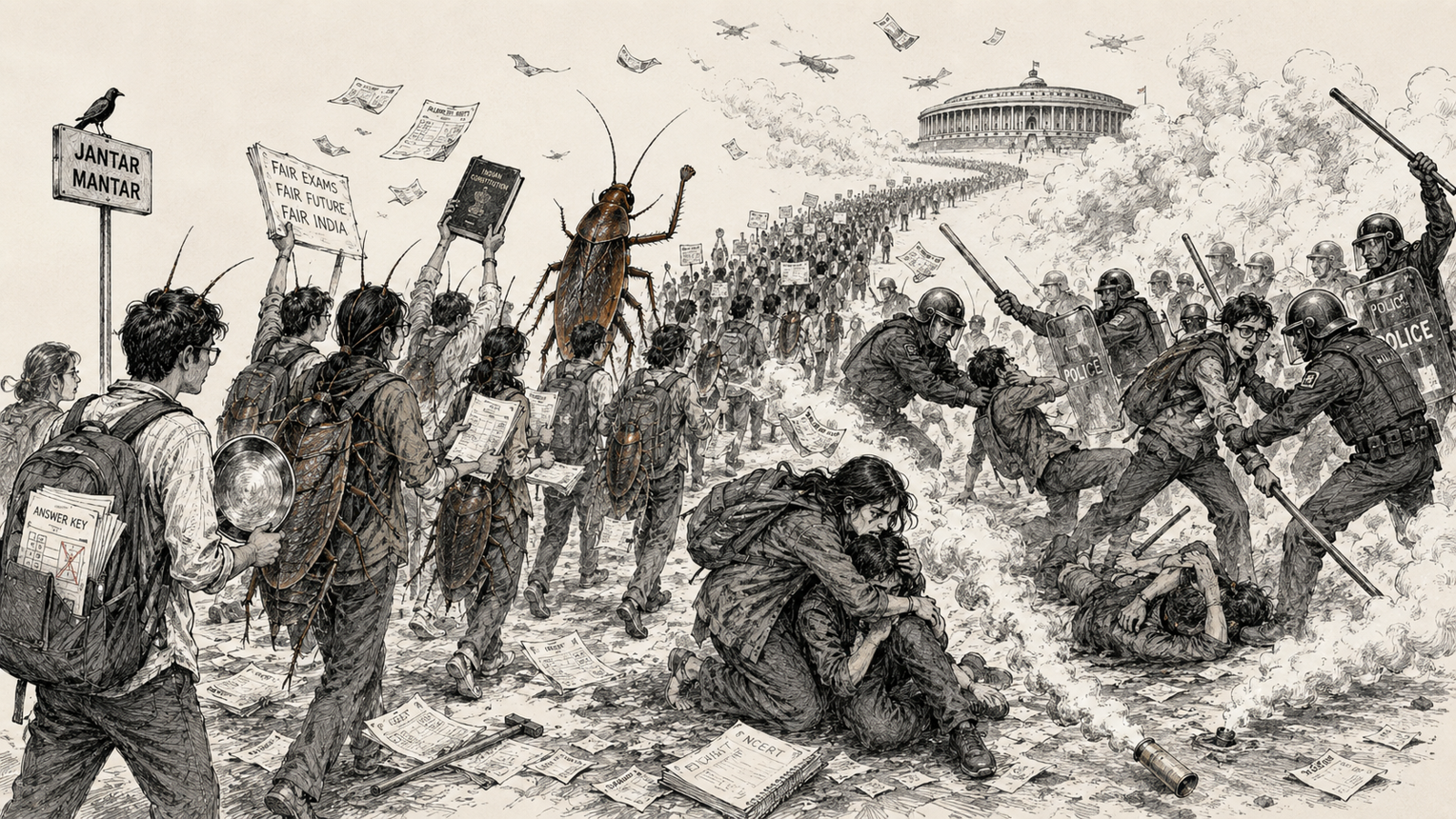
On the afternoon of 3 May 2026, twenty-two lakh seventy-nine thousand young Indians sat for a medical entrance examination. Roughly 42 hours earlier, the questions had begun circulating on WhatsApp. This essay is about why that happens, why the legal apparatus built to prevent it fails to do so, and what twelve years of this pattern have cost the cohort it has trapped.
What happened on 3 May
The exam itself was unremarkable. At two in the afternoon, in more than five thousand centres across 552 Indian cities and 14 cities abroad, twenty-two lakh seventy-nine thousand candidates opened their question booklets and began. By five, they had finished, gathered their things, and walked out into the heat. Most went back to coaching hostels in Kota, Sikar, Hyderabad, Patna and Delhi. Some went home. A few thousand had answered the same questions before, three days earlier, on their phones.
The Rajasthan Special Operations Group said in its first communication on 12 May that it had been working on an Intelligence Bureau tip-off. The document the SOG had recovered was a handwritten paper of approximately 410 questions. When the SOG laid this document next to the actual NEET-UG 2026 question paper, around 120 of the 180 questions matched. Most of these were in Biology, with the remainder in Chemistry. According to the SOG's reconstruction, the paper had been forwarded on WhatsApp to candidates on the evening of 1 May, forty-two hours before they wrote their exam. Thirteen people were detained across Dehradun, Sikar and Jhunjhunu. The named principal arrest is Rakesh Kumar Mandawaria, a consultancy operator in Sikar. The digital trail, per investigators, reportedly runs back through a Nashik-based student and Kerala-based contacts to the original source, with the document said to have reached Sikar on the morning of 1 May.
The National Testing Agency spent the previous five days denying that the leak existed. Its position was that the examination had proceeded as planned, that inputs regarding malpractice were received only late on the evening of 7 May, four days after the exam, and that these were escalated to central agencies on 8 May. The agency also took the precaution of putting Anil Jain, its Director General, on leave that week, and naming the Director General of the Indian Council of Medical Research as interim chief.
On 12 May, the Government of India announced what the new chief had been brought in to do. NEET-UG 2026 was cancelled and referred to the Central Bureau of Investigation. A re-examination would follow on a date to be notified. Twenty-two lakh candidates, who had spent between one and four years preparing for this single afternoon, would prepare again.
This essay is about why this happens and what it costs. It examines why the National Testing Agency, with the entire intelligence apparatus of the Indian state behind it, cannot keep its papers safe; why families in Hazaribagh and Sikar pay thirty lakh rupees for a seat at a medical college; what twelve years of compounding leaks has done to the lifetime earnings, mental health and labour market position of a cohort the state has used as collateral for its own administrative failure; and how this entire arrangement is the natural output of choices the current government made between 2014 and 2017, choices it has had eleven years to correct and has chosen not to. The work I have done on the eleven-year Modi-era policy ledger sits in the background of this essay. NEET is one of the items on that ledger that remains unsettled.
The leak pattern, 2014 to 2026
The Modi government inherited an economy rife with recruitment scams when it took office. The Madhya Pradesh Vyavsayik Pariksha Mandal, known then as Vyapam, had been running fake admissions and recruitment for state professional courses and government jobs from at least 2007. By the time the scandal became public in 2013, the network had placed thousands of paying candidates in medical colleges, police constabularies and forest department posts in Madhya Pradesh, under a Bharatiya Janata Party state government led by Shivraj Singh Chouhan.
More than forty people connected to the case died between 2013 and 2015, in circumstances ranging from road accidents to organ failure to suicide. The Madhya Pradesh SIT classified at least 23 of these as unnatural deaths; the total attributable to foul play remains contested. The CBI took over the investigation in July 2015 after a Supreme Court direction. No senior political figure was convicted. The Vyapam case was the first warning of what an integrated leak-and-impersonation economy could look like in India, and what the political costs of dismantling it would be.
The Modi government's response was not to bring Vyapam to a conclusion. It was to centralise. The National Testing Agency was constituted in November 2017 as a society under the Department of Higher Education, Ministry of Education, with a brief to take over a growing portfolio of high-stakes national examinations. NEET-UG, conducted by the CBSE until 2018, was taken over by the NTA in 2019. JEE Main, CUET, UGC-NET and CSIR-NET followed. By 2024, the NTA was conducting fourteen examinations, with a staff strength that the December 2025 Parliamentary Standing Committee on Education found grossly inadequate for the testing portfolio assigned to it. Delhi University professor Apoorvanand, observing the same agency in mid-2024, described it as 'a very small outfit with no intellectual base or resources of its own' with 'no accountability'
What followed reads like a year-by-year accounting of why centralisation without capacity produces serial failure. In March 2018, the CBSE Class XII Economics and Class X Mathematics papers were leaked, with handwritten copies circulating on WhatsApp before the examinations. The CBSE was forced to re-conduct both papers, affecting roughly 28 lakh students. Prime Minister Modi spoke privately to HRD Minister Prakash Javadekar to express displeasure. The Congress called the government "Paper Leak Sarkaar." In 2019, the Karnataka Police Sub-Inspector recruitment was compromised.
In 2021, the Rajasthan Eligibility Examination for Teachers, the Tamil Nadu Police constable examination and several state public service commission examinations leaked. In 2022, the Rajasthan Public Service Commission's Senior Teacher examination was sold by a sitting RPSC member, Babulal Katara, to a suspended government school vice-principal for sixty lakh rupees. The NEET-PG examination was postponed amid allegations of leaks in the same year. In 2023, the Bihar Police Constable recruitment and the first edition of the BPSC Teacher Recruitment Examination saw leak networks traced to Sanjeev Mukhiya, the same operator who would resurface in 2024. Mukhiya's son Shiv Kumar, who holds an MBBS from Patna Medical College, had himself been arrested in connection with a 2017 NEET-UG paper leak. The Mukhiya network had been working on NEET for seven years before 2024.
In 2024, the system failed eight times. The Uttar Pradesh Police Constable recruitment was cancelled in February after forty-eight lakh candidates had appeared, of whom sixteen lakh were women. The Uttar Pradesh Review Officer and Assistant Review Officer preliminary examination was cancelled in the same month. The NEET-UG paper leaked from the OASIS School in Hazaribagh in May. The NEET-PG examination was cancelled one day before its scheduled date. The UGC-NET examination in June was cancelled one day after it was conducted, on the basis of a tip-off that the paper had been compromised. The third edition of the BPSC Teacher Recruitment Examination was cancelled. The CSIR-UGC NET was postponed. The seventieth Bihar Public Service Commission examination was marred by violent protests. By the end of 2024, Newslaundry's investigation into paper leaks in India had counted 89 cases over a decade, affecting approximately 6.5 crore candidates. The Indian Express, counting only the five years to 2024 and only recruitment exams, recorded 48 leaks across 16 states, affecting 1 crore 51 lakh applicants for around 1 lakh 20 thousand posts.
In 2026, the system failed again. The pattern is now twelve years old. It has not been corrected once.
The Hazaribagh leak is worth a closer look because of how completely the CBI's reconstruction was understood and how little came of it. A civil engineering graduate of NIT Jamshedpur named Pankaj Kumar, alias Aditya, was let into the OASIS School's control room on the morning of 5 May 2024 by the school's principal, Ehsanul Haque, who doubled as the NTA's city coordinator, and the vice-principal, Imtiyaz Alam, who served as the centre superintendent.
Using sophisticated tools, Kumar opened the sealed trunks containing the NEET-UG question papers, accessed and reproduced the contents, and resealed them. The reconstructed papers were distributed to candidates housed at safe locations across Hazaribagh and Patna. The half-burnt remains of solved papers were recovered on 4 May 2024, a day before the examination, from a hostel attached to the Learn and Play School in Patna. The Bihar Police Economic Offences Unit identified the source as the OASIS School trunks. The CBI took over the case in July 2024 and went on to make approximately forty-nine arrests across Bihar, Jharkhand, Gujarat and Kolkata. Sanjeev Mukhiya was arrested in April 2025 and granted default bail in August 2025 after the CBI failed to file a chargesheet within ninety days. He remains in custody on at least three other paper-leak cases: the BPSC Teacher Recruitment Examination of 2024, the Bihar Police Constable Recruitment of 2023, and the Jharkhand CGL examination.
The Supreme Court refused to cancel NEET-UG 2024. In Vanshika Yadav v. Union of India, W.P. (C) No. 335/2024, 2024 INSC 568, (2024) 9 SCC 743, decided on 2 August 2024 by a bench of Chief Justice Chandrachud and Justices Pardiwala and Misra, the court held that "absence of material on the record sufficient to lead to the conclusion that the result of the exam stands vitiated or that there is a systemic breach in the sanctity of the exam" prevented re-NEET. The bench relied on an IIT Madras data analytics report that found no statistical abnormalities in the 2024 results compared with 2022 and 2023. That sixty-seven candidates had scored a perfect 720 out of 720 in 2024, compared with two in 2023 and one in 2022, was treated as an administrative anomaly, resolved by reviewing grace marks. The Solicitor General told the court that the CBI had identified 155 candidates as beneficiaries of the Hazaribagh and Patna leaks, of whom 32 had been individually identified at the time of the hearing. That was deemed insufficient to disrupt the examination of 23 lakh candidates.
The development economics of the leak
This is, at its core, a development economics problem. It has three named pieces in the economic literature, and naming them is the first step to understanding why the political response has been so unequal to the scale of what is unfolding.
The first is signalling. Michael Spence, in his 1973 paper in the Quarterly Journal of Economics, modelled job markets in which employers cannot directly observe productivity and therefore infer it from costly signals. The cost must be unequally distributed across worker types for the equilibrium to hold. The signal does not need to teach anyone anything; it only needs to be costlier for the less productive to acquire. Bryan Caplan generalised this in The Case Against Education in 2018, claiming that the bulk of the wage return to education in modern economies is signalling rather than human capital accumulation. The Indian state has built a Caplan economy at scale and then compressed it. The signalling instrument is not a degree, which at least takes years to acquire. It is one paper, written in one afternoon, by people who have often spent years preparing for it.
Compressing the entire information transfer into a single afternoon collapses the cost differential between the able candidate and the buyer of a leak. A leak does not have to make a slow student into a fast one. It only has to push the buyer above the cut-off for a particular medical college. The signalling equilibrium breaks at exactly the point where the signal becomes valuable enough to forge.
The second is opportunity cost. The PLFS data for 2023 to 2024 show graduate unemployment in the 15-29 age group above 13 per cent for men and close to 40 per cent for women, with much of this concentrated among exam aspirants who report themselves as out of the labour force or unemployed by usual status. To take the NEET cohort specifically: 23 lakh candidates appear each year, of whom approximately 1 lakh 29,000 secure undergraduate medical seats. The remaining twenty-two lakh return to repeat the cycle or exit. Of these, a substantial share will spend a second, third or fourth year attempting NEET. A conservative estimate is that the median aspirant invested two years in pre-NEET preparation. At a private-sector entry-level monthly wage of fifteen thousand rupees, the foregone earnings of a single year of preparation are one lakh eighty thousand rupees per aspirant (these stylised assumptions, drawn from PLFS earnings data and average coaching outlays, vary by region and household).
For the 22 lakh candidates who did not get a seat in 2024, the foregone wages for that single year of preparation amount to approximately 40,000 crore rupees. Add coaching fees at an average of one lakh per aspirant per year, and the cohort is paying around sixty thousand crore rupees a year, in foregone earnings and direct outlay, to sit a single examination. That figure rises every time the examination is cancelled. The 2026 cancellation has just added another year to the lives of twenty-two lakh young Indians.
The third is what the development economics literature calls the aspiration trap. Garance Genicot and Debraj Ray, in their 2017 Econometrica article on aspirations and inequality, formalised the dynamics that arise when individuals set their aspirations on socially observable benchmarks that are unrealistic given their endowments. The benchmark in this case is government employment or a medical college seat. The endowment comprises the aspirant's family resources, the quality of schooling, and the social network. The mismatch produces persistent investment in preparation that does not pay off, prolonged labour market entry, and intergenerational asset depletion. India's exam-aspirant cohort is the most documented aspiration-trap population in the world. It is, by some PLFS-derived estimates, larger than the population of most European countries.
These three theoretical pieces clarify what the leak is doing. It is breaking a signalling equilibrium by inflating the cost gap between honest preparers and leak buyers; it is wasting the opportunity cost that families have invested in good faith; it is deepening the aspiration trap by extending the time-to-completion for those who keep returning. Pranab Bardhan's framing of the Indian state as a site of rent extraction by competing coalitions, set out forty years ago in The Political Economy of Development in India, gives us the political-economic completion of the argument. The new rent frontier in India is selection. It is realised in two markets simultaneously: a legal market of coaching, valued at approximately fifty-eight thousand crore rupees by Karishma Shah's 2024 article in the Economic and Political Weekly, and an illegal market of solver gangs, leak networks and seat-buyers, whose price discovery the Bihar Economic Offences Unit has documented at thirty to fifty lakh rupees per NEET seat in 2024.
Karthik Muralidharan, in his 2016 paper for the India Policy Forum on a new approach to public-sector hiring in India, has identified the demand-side driver of all this. Government jobs in India pay roughly six times the private sector for comparable cadres, particularly at the lower end, where most recruitment happens. The wage premium attracts not only the able but the desperate, and an exam-based filter sorts neither well. The damage is downstream as well. The reason rote learning dominates Indian schools is downstream demand from a labour market in which the most lucrative employer cares only about exam scores. The signalling equilibrium and the schooling equilibrium are co-produced. This is part of what I argued, in an essay on India's reverse structural transformation, about a development model that does not absorb labour into formal employment and instead produces an aspirant population. The aspirant population is not a residual of the development model. It is its co-product.
Craig Jeffrey, in his ethnography of unemployed Jat men in Meerut, Timepass (2010), gave us the durable vocabulary for what happens to the candidates in this system. Aspirants advertise their aimlessness by hanging out and preparing for examinations that come and go. Two decades after Jeffrey's fieldwork, that condition has gone national. The rise in female labour force participation from twenty-three per cent in 2017-18 to forty-one per cent in 2023-24 includes, according to the National Statistical Office's own composition data, a substantial component of women engaged in exam preparation rather than wage employment. To be an aspirant is now a recognised social status in Bihar, Uttar Pradesh, Madhya Pradesh and Rajasthan. It is a status that can last for years.
The Modi government did not invent this system. What it did was centralise it, expand the share of seats and jobs that flow through it, and then under-resource the institution it created to administer it.
The cost in years and lives
The system has a body count and a balance sheet, and both are larger than the political discourse around NEET has acknowledged.
The body count first. Coaching towns have a documented elevated suicide rate among adolescent aspirants, the cleanest treatment of which is in the 2024 Lancet Regional Health Southeast Asia article on exam failure suicides in India. Kota recorded twenty-nine student suicides in 2023, the highest in a single year on record, with the District Collector citing seventeen in 2024 to claim a fifty per cent decline. The figures are almost certainly undercounted. Most of these are deaths concentrated among aspirants who have invested two to four years of their lives, often with family savings mortgaged, in a single afternoon that did not yield the desired result. Police reports cite the contents of suicide notes: parental disappointment, fear of failure, and the cost of returning home empty-handed. A few of these aspirants leave behind ledger sheets of what they have cost their families to prepare. The Lancet article documents the seasonal pattern: a peak immediately after results are released, followed by a secondary peak in the weeks before the next year's examination begins.
The most public illustration of the regressive consequence of this examination remains the death of S Anitha, a Dalit student from Ariyalur district in Tamil Nadu, in September 2017. She had scored a near-perfect 1176 out of 1200 in her Class XII state board examinations. Under the pre-NEET regime, this score would have secured her admission to a seat at Madras Medical College. Under the NEET regime, her board marks meant nothing. She failed NEET. She died by suicide before the next year's preparation could begin. Her case became the political vehicle for Tamil Nadu's anti-NEET coalition, and her face still appears on opposition party posters in Chennai. The 2017 introduction of NEET, according to Justice A.K. Rajan's committee, caused a documented shift in the social composition of Tamil Nadu's medical admissions away from rural and Tamil-medium students and toward urban CBSE-stream students whose families could afford coaching. Anitha was the first widely known casualty of that shift. She has not been the last.
Behind every Kota number is a household. The Bihar Economic Offences Unit's reconstruction of the Mukhiya network in 2024 included transcripts of phone conversations in which mothers asked for time to arrange the thirty lakh rupees by selling land, or by withdrawing a sister's marriage savings. In Hazaribagh, a candidate's family was recorded telling Mukhiya's intermediary that the household had sold a buffalo and a plot of two kattha to pay the first instalment. In Patna, in the half-burnt remains of solved papers, investigators recovered the names of candidates whose parents had taken personal loans against retirement savings. These are not the families of doctors. They are the families of small farmers, government school teachers, retired military, and the lower middle class, trying to push the next generation across a threshold they themselves did not cross.
The aspirants who do not buy leaks and do not clear NEET return to a labour market that has no jobs for them. India's private formal sector has not grown fast enough to absorb the graduates that the higher education system produces. The Periodic Labour Force Survey records, year after year, that the modal Indian graduate aged 22 to 30 is in self-employment, casual labour, or out of the labour force entirely. The destruction of the small- and medium-enterprise sector after demonetisation and the goods and services tax, which I have written about in connection with the country's reverse structural transformation, eliminated precisely the kind of mid-tier formal employer that would have absorbed graduates who did not become doctors. The exam economy is the upper-end manifestation of that absorption failure. It is what young Indians do because the labour market offers them nothing else.
The balance sheet next. Take the conservative cohort calculation from Section III: twenty-two lakh failed NEET aspirants, two years of median preparation each, foregone wages of approximately forty thousand crore rupees per year, coaching expenditure of approximately twenty thousand crore rupees per year, for an annual sticker price of around sixty thousand crore rupees. Compound this over the twelve years since 2014, and the cumulative cost of the NEET pipeline alone, in foregone earnings and direct outlay, is north of seven lakh crore rupees in 2024 prices. This is larger than the entire central government health budget over the same period. It is larger than the cumulative outlay on the Mahatma Gandhi National Rural Employment Guarantee Scheme since its inception. It is money that did not finance medical infrastructure, raise rural wages, produce manufacturing jobs, or remain in rural household savings. It was burnt in coaching-town hostels and in the foregone first salaries of a generation.
The same arithmetic applies to every other major examination. UPSC has 15 lakh applicants annually for 1,000 posts. SSC CGL has fifty lakh. The Railway Recruitment Board's non-technical popular categories examination had one crore twenty-five lakh applicants in 2022. Add these up, and the country is now operating a permanent aspirant economy of three to four crore young people, in which each member is in some stage of multi-year preparation for an examination whose outcome will be determined by a single afternoon performance under conditions the state cannot guarantee. The development economics term for this is human capital destruction. It is the inverse of what the East Asian states did between 1960 and 1990. Their examination systems sorted, certified, and pushed graduates rapidly into a labour market that grew fast enough to absorb them. Ours sorts, fails to certify, and produces an aspirant phase that, for many, lasts ten years or more.
The coaching capitalists
The labour market the aspirant prepares for is small. The labour market that prepares the aspirant is enormous. India's coaching industry, by Shah's estimate, is on a trajectory to one lakh thirty thousand crore rupees by 2028. The three largest players in the JEE and NEET segment in the financial year 2024 were Allen Career Institute, with operational revenue of ₹3,245 crore in FY24 and a profit of ₹136 crore that year, down from earlier peaks; Aakash Educational Services, with ₹2,438 crore in revenue and significant losses tied to the collapse of its erstwhile parent Byju's; and Physics Wallah, which reported ₹1,941 crore in FY24 and grew that to ₹2,887 crore in FY25 with 49 per cent year-on-year growth and 44.6 lakh paid users by the end of the financial year. Physics Wallah listed on the Indian stock exchanges on 18 November 2025, raising ₹3,480 crore from the public markets and listing at a 33% premium to the issue price. The coaching industry is now listed on an exchange, and the country's largest pool of test-prep capital is publicly tradable.
The geography of this industry is the geography of the leak. Kota's peak student population of two and a half lakh in 2022 generated annual revenues of around ₹7,000 crore, and its contraction to under one lakh students reflects the diffusion of the model to Sikar, Hyderabad, the Patna belt, and the suburbs of Delhi, not a decline in aspiration. Sikar, where the 2026 leak was located, had become the second-largest coaching hub in the country by 2024. The chain that the SOG has begun to reconstruct runs from a Nashik-based student and Kerala-based contacts to a Sikar consultancy operator to thirteen detainees in Dehradun, Sikar and Jhunjhunu. This is not a geographic accident. The coaching towns are the towns where the leak market clears because they concentrate buyers willing to pay, sellers with technical knowledge, and the digital infrastructure to clear trades quickly.
The other figure that matters here is suicide. Coaching towns have a documented elevated suicide rate among adolescents, the clearest treatment of which is in the 2024 Lancet Regional Health South-East Asia article on exam failure suicides in India. Kota recorded twenty-nine student suicides in 2023, falling to seventeen in 2024, the latter figure cited by the District Collector to claim a fifty per cent decline. These are deaths concentrated among aspirants who have invested two to four years of their lives, often with their families' savings mortgaged, in a single afternoon that did not yield the desired result. The Ministry of Education's Guidelines for Regulation of Coaching Centres of January 2024 prohibit enrolment below the age of 16, cap hours and fees, and require the presence of a counsellor. Implementation is state-level and largely absent. The system that drives a seventeen-year-old to suicide for failing a single test is not regulated by either the centre or the states with anything like the seriousness it would merit if these were factory deaths.
The fees, hostels, and books are the legal half of this market. The leaked papers are the illegal half. The same families finance both. A 2024 Bihar Economic Offences Unit dossier on the Mukhiya network stated that it priced NEET-UG seats at 30 to 50 lakh rupees. A family that pays five lakh rupees a year for coaching is being offered an end-run option for six to ten times the cost. The leak is the coaching market's extension at the top.
The Tamil Nadu question, and the federal one beneath it
I have argued elsewhere, in an essay on India's reverse structural transformation, that the Indian state has built a development model that pushes labour back into the informal sector rather than absorbing it into formal employment. The exam-and-coaching economy is the upper-middle-class equivalent of that reversal. It is the formal labour market that did not quite arrive, replaced by a multi-year aspirant phase followed, for most, by a return to whatever the household economy can offer. The federal politics of NEET began as a critique of this, and has had to litigate its way through fifteen years of Supreme Court orders to make any progress at all.
The constitutional baseline was set in Christian Medical College Vellore Association v. Union of India, (2020) 8 SCC 705, decided on 29 April 2020. Justices Arun Mishra, Vineet Saran and M.R. Shah held that NEET applied to private unaided and minority institutions as well as to government colleges under Section 10D of the Indian Medical Council Act, 1956, as inserted in 2016. The court reasoned that "the regulatory measures in question are for the improvement of the public health and are a step in furtherance of the directive principles," and that "the rights to administer an institution under Article 30 of the Constitution are not above the law and other Constitutional provisions." That judgment foreclosed the legal route. What remained was the political route, which Tamil Nadu has been pursuing since 2017.
Justice A.K. Rajan's committee, set up by Chief Minister M.K. Stalin after his return to power, submitted a 165-page report on 14 July 2021 after examining 86,342 submissions from across the state, with the report made public in September 2021 and re-released by the state government in 2024. Sixty-five thousand of these submissions opposed NEET. The committee's empirical findings were uncomfortable for any defender of the examination. Ninety-nine per cent of MBBS admissions in Tamil Nadu in 2019-20 had taken prior coaching, much of it costing up to three lakh rupees annually. Ninety-seven per cent of government school students' parents earned less than one lakh rupees a year. The CBSE-stream share of Tamil Nadu government medical college seats had risen from zero in 2015-16 to twenty-seven per cent by 2020-21. The rural share of admissions had fallen substantially over the post-NEET years. The Tamil-medium share had collapsed from above fourteen per cent before NEET to under two per cent by 2020-21. The state's coaching industry, valued at ₹5,750 crore, was distributing seats away from the rural and Tamil-medium constituency that the state's medical education system had been built to serve.
On the strength of this report, the Tamil Nadu Assembly passed the Tamil Nadu Admission to Undergraduate Medical Degree Courses Bill in September 2021, repassed it unanimously in February 2022 after the Governor, R.N. Ravi, returned it, and forwarded it to the President of India. On 4 March 2025, presidential assent was withheld without reasons, on the advice of the Union Ministries of Health, Education and AYUSH. On 15 November 2025, the state of Tamil Nadu filed an original suit in the Supreme Court under Article 131, challenging the withholding on the ground that it violates the constitutional framework governing centre-state relations. The suit is pending. After the 2026 cancellation, Stalin wrote to the Prime Minister on 15 May 2026, demanding an exemption for Tamil Nadu for the 2026-27 cycle and reiterating that NEET should be scrapped.
The point is not whether Tamil Nadu's specific demand is right or wrong. The federal question NEET raises has not been settled and cannot be settled at the central level alone.
India's medical labour force has been centralised into a single annual examination conducted by a society registered under the Societies Registration Act 1860, which Delhi University professor Apoorvanand has described as 'a very small outfit with no intellectual base or resources of its own' with 'no accountability'.
The Parliamentary Standing Committee on Education, in its 371st Report of December 2025, reached a substantively similar conclusion, recommending a return to pen and paper examinations on the UPSC and CBSE model, never conducted in private centres. That panel was chaired by Congress MP Digvijaya Singh on a BJP-majority committee. Education Minister Dharmendra Pradhan rejected the panel's recommendations on 15 May 2026, prompting Jairam Ramesh to point out that he was rejecting the views of his own party's MPs. The K. Radhakrishnan Committee, the executive's own panel chaired by the former ISRO chairman, submitted a hundred and one recommendations in October 2024, few of which were operational when the 2026 exam ran.
The federal politics of the testing system is, at one level, the politics of which group's children become doctors. At another, it is a politics of what state capacity has been delegated to a society of fifty-odd employees in Noida and what state capacity has been left to the states that conducted these examinations until 2016. NEET was a centralisation. The 2026 cancellation is what centralisation without capacity looks like. The pattern is part of a larger structure of unaccountable central institutions that I have examined elsewhere in connection with the foreign contribution regulation regime and the Comptroller and Auditor General's recent reports on union finances. The NTA's location in this structure is unfortunate but consistent. It is a centrally created body, accountable to a ministry rather than to Parliament, exercising authority over a population it does not represent, audited in name only.
Who can buy a seat
The distributional effect of the leak is regressive in a way that the system rarely speaks about. The 2024 Bihar EOU price for a NEET-UG seat was between 30 and 50 lakh rupees. This is not an offer that reaches the income deciles from which most NEET aspirants come. India's median household, according to the most recent Consumption Expenditure Survey, spends under fifteen thousand rupees a month. The marginal NEET candidate, from a Tamil-medium government school in Sivagangai or a Hindi-medium school in Gaya, cannot raise thirty lakh rupees on demand. Only families in the top decile or above can. The leak, therefore, transfers seats from rigorous preparers to leak-payers, and from the poor to the rich, twice over. It does so within a system that was sold to the public, in the 2013 to 2016 NEET debates, as a leveller.
The Tamil Nadu data, after the introduction of NEET, gives the clearest read on what happens when the leveller is, in fact, a regression. Rural representation falls. Tamil-medium representation collapses. Government school student representation declines. CBSE-stream representation rises. The seats migrate, at the margin, from the children of agricultural labourers and small farmers to the children of urban professional households who can afford five lakh rupees of annual coaching. When the leak market is added on top, a further migration takes place from those who can afford five lakh rupees to those who can afford thirty.
I have written elsewhere about the centralisation of welfare delivery and what it does to representation, and about the reversal of structural transformation that pushes labour back into informality. NEET is the upper-end manifestation of the same pattern. A centralising state takes selection out of the hands of state governments that have local information and political accountability. It concentrates on a Noida society that cannot keep its papers secure. The poor pay the cost. The rich pay the leak price. This is the same redistributive pattern, in the opposite direction to the one Ambedkar designed the Constitution to produce, that I have written about in an earlier essay on the economist outside the granary and the court.
The Supreme Court refused to engage with this in 2024. Its preferred framing was that re-examination would cause widespread disruption. The unspoken corollary was that twenty-three lakh young Indians could be made to live with the results of a corrupt examination because the alternative would inconvenience the administrative state. The standard the court applied to the 2024 NEET was not the same as the standard applied in private contract disputes, where evidence of fraud at one node typically taints the entire transaction. It was a public examination standard set by a court that has consistently preferred administrative finality to evidentiary inquiry.
What other countries do, briefly
The Chinese gaokao is the closest international analogue in scale, with thirteen million test-takers in 2024. Papers are designated state secrets. They are printed in designated prisons, transported under armed escort with GPS tracking, and stored at examination centres with multi-key access. Cheating carries a penalty of up to 7 years' imprisonment under a November 2015 amendment to the Criminal Law. The system has had documented in-room cheating, particularly photograph-based, and a few solver gang cases. It has not had the kind of industrialised pre-leak networks that India has built. The reason is not Chinese cultural exceptionalism. Leaking is treated as treason and prosecuted as such.
Brazil's ENEM, the unified university entrance examination, has had documented pre-leaks. The 2009 examination was cancelled. The 2011 examination saw a private school in Fortaleza in possession of identical questions before the test; the Federal Court in Ceará annulled the scores of the implicated students. After 2011, Brazil migrated to a question bank system based on Item Response Theory, with multiple colour-coded paper versions to limit the downstream utility of any single leak. South Korea cancelled SAT administrations in May 2013 after leaks traced to private tutoring centres in Seoul. Each of these countries has treated examination leaks as systemic catastrophes requiring structural redesign.
India has passed laws. The Public Examinations (Prevention of Unfair Means) Act, 2024, received presidential assent on 12 February 2024 and came into force on 21 June 2024. It covers UPSC, SSC, RRB, IBPS, NTA and central ministries. Its offences are cognisable, non-bailable, non-compoundable and investigable only by officers above the rank of Deputy SP. Service providers face fines of up to 1 crore rupees and a 4-year debarment from public examination contracts. It is paired with several state laws, dating back to Andhra Pradesh 1997 and Uttar Pradesh 1998, with the most recent in Rajasthan 2022, Uttarakhand 2023 and Gujarat 2023. As of May 2026, two years after the central Act was enacted, no major conviction under it has been publicly reported. Mukhiya, the alleged kingpin of the 2024 leak, was out on default bail nine months ago because the CBI did not file its chargesheet within ninety days of his arrest.
The Indian state has shown that it can write the law and then choose not to enforce it. The law is not the binding constraint.
The institutional indictment
Twelve years of patterns are enough to infer the institutional choices that produced them.
The first choice was to create NTA in 2017 with a brief that exceeded its capacity, and then keep adding examinations to its portfolio every year. The Parliamentary Standing Committee on Education, in its 371st Report of December 2025, documented this. At least five of NTA's fourteen examinations in 2024 had major issues, including the postponement of UGC-NET and CSIR-NET, the cancellation of NEET-PG, a NEET-UG paper leak, delays in CUET UG and PG results, and the withdrawal of twelve questions from the final answer key of JEE Main 2025 due to errors.
The agency carried a surplus of approximately ₹448 crore, calculated as the difference between its revenues of ₹3,512.98 crore and expenses of ₹3,064.77 crore over six years, suggesting it had the money it claimed it did not have. Its staff strength was below what any reasonable testing body would require. The committee, chaired by Congress MP Digvijaya Singh and a BJP-majority panel, recommended a return to pen-and-paper examinations on the UPSC and CBSE model, which have never been conducted in private centres. Education Minister Dharmendra Pradhan rejected the panel's recommendations on 15 May 2026, prompting Jairam Ramesh to point out that he was rejecting the views of his own party's MPs. The minister is, in this respect, in conflict not with the opposition but with the parliamentary process the Constitution requires him to respect.
The second choice was to deny each leak for as long as possible, escalate only when forced by external investigation or court action, and to settle prosecutions with bail rather than conviction. The 2024 NEET case, the most documented of these, has produced no convictions. Mukhiya is on default bail. The CBI did not file its chargesheet within the 90-day window prescribed by the Code of Criminal Procedure. The bureaucratic, political, and prosecutorial apparatuses failed in sequence. None of the failures has produced an accountability response.
The third choice was to commission a committee, accept some of its recommendations on paper, and run the next cycle of examinations before those recommendations were operational. The K. Radhakrishnan Committee, the executive's own panel chaired by the former ISRO chairman, submitted a hundred and one re101October 2024. Few were operational when the 2026 exam ran. The committee included Randeep Guleria, former AIIMS director, and B. J. Rao, vice-chancellor of the University of Hyderabad. Its recommendations on sealing, presiding officers, government-controlled premises, and the gradual reduction of dependence on private test-delivery agencies were all sensible. They were not implemented in time.
The fourth choice was to withhold presidential assent on the Tamil Nadu Bill in 2025, after the Tamil Nadu Assembly had passed it twice. This is the choice that most clearly shows the political settlement at work. The Tamil Nadu Bill would have removed Tamil Nadu's medical admissions from NEET. The Union government, which had every constitutional opportunity to engage on the policy substance of the bill, instead used the device of withheld presidential assent to defeat it without giving reasons. The Supreme Court will rule on whether this device can be used in this way. The political question, before the court's ruling, is why an examination that has been catastrophically compromised in 2024 and 2026 cannot be modified by a single large state with strong empirical grounds for doing so. The answer the Union government has given, by its conduct, is that centralisation matters more than the integrity of the centralised process. This is what authoritarian centralisation looks like in practice. It is not the assertion of central authority over a recalcitrant state. It is the refusal of the central authority to accept that its own administrative apparatus is failing.
What would actually change this
The first step is the smallest. The re-NEET announced by the Government of India on 12 May 2026 should be conducted under the protocols proposed by the Radhakrishnan Committee in October 2024 and endorsed by the Standing Committee in December 2025. That means all centres in government-controlled premises, which is to say Kendriya Vidyalayas, Navodaya Vidyalayas and government degree colleges, rather than the private schools whose principals have featured in three of the last five years' leak chains. It means a presiding NTA officer at each centre, sealed and verified centre operations witnessed by the district administration and the police, and a single national rollout window of no more than 4 hours. If the 2026 re-NEET also leaks, the case for moving away from a single pen-paper national exam becomes structurally urgent rather than merely sensible.
The second step is the one the Standing Committee has been clearer about than the executive. The single-paper, single-day, single-afternoon model is the deeper problem, well below the question of administration. A two-stage examination, with a screening test administered nationally and a substantive test administered by states, weighted by Class XII board marks, reduces the impact of any single leak by roughly half. This is the model the Joint Entrance Examination already uses for the Indian Institutes of Technology, with the Main and Advanced exams. There is no good reason that medical admissions cannot be restructured in the same way, with the second stage devolved to state-administered counselling and a portion of the weight returned to school board examinations. The Tamil Nadu objection is partly about precisely this restoration.
The third step is the hardest one. Section 10D of the Indian Medical Council Act 1956, and the corresponding provisions of the National Medical Commission Act 2019, would need to be amended to permit state-administered second-stage components. The political coalition for this is, in some sense, already present. The Standing Committee that endorsed pen-paper examinations was a BJP-majority panel. The Tamil Nadu Article 131 suit will force a constitutional answer on the timing of presidential assent. The executive has the option of either preempting the court with a federalist amendment or waiting for the court to push centralisation back through judicial reading.
None of this addresses the deeper question that Muralidharan and Caplan together raise. The medical seat and the constable post are worth thirty lakh rupees in the leak market because the public sector pays a multiple of the private sector for comparable work, because Indian families have correctly identified government employment as the single most secure household income stream available to them, and because the private formal labour market has not grown fast enough to absorb the graduates the higher education system produces. I have written about the fiscal centralisation that makes this gap structural, and about the health system that the medical graduates of this exam will enter, which is not configured to absorb them at the wages they will require.
The exam-leak equilibrium will not be solved by anti-cheating laws while the underlying labour market arithmetic remains unchanged. Public sector recruitment volumes need to grow with the labour force rather than shrink against it. The unfilled vacancies that the central and state governments have accumulated, which the Modi government's own ten lakh recruitment Rozgar Mela pledge implicitly concedes, need to be filled. Wage compression between public and private sector employment will follow that filling, slowly. The aspirant phase will shorten. The leak economy will lose its rent.
There is one further step, and it is the one most often missed. The coaching companies that are now public equity should be subject to the same level of disclosure as public equity companies. Centre-level pass rate data, fee escalation caps, and mandatory counsellor ratios in residential coaching towns. The Physics Wallah listing in November 2025 is the moment to begin this. There is a regulatory parallel in the way the United States treats for-profit college disclosure under Title IV of the Higher Education Act. India has not yet built that disclosure regime, but its capital markets regulator has the tools to do so. The opportunity to align the industry's reporting with its publicly traded status is open. It will close.
The afternoon, again
On the afternoon of 3 May 2026, twenty-two lakh seventy-nine thousand young Indians sat down to write a paper that had already been written, for a small number of them, in the previous forty-two hours. By 12 May, the Government of India had cancelled what those twenty-two lakh had spent the afternoon doing. The cancellation is the system's belated acknowledgement of one of its many failures. The deeper failure is the design choice that allocated a country's medical labour force, its lower bureaucratic cadres, its police forces and its public school teachers through a small number of nationally conducted single-paper examinations administered by a society of fifty employees in Noida. The deeper choice is to have run this design for twelve years without correction, despite a paper trail of committee reports, parliamentary findings, court orders, and the documented deaths of a cohort of teenagers in coaching towns.
The aspirants writing the re-examination will be the same young Indians who wrote the cancelled one. Some of them will not write it. Some will be lost to suicide between the cancellation and the rescheduling. Most will return to coaching hostels for another six months. The families that took loans to pay for the first attempt will take more loans for the second. The families that paid thirty lakh rupees to Mukhiya's successor in Sikar will pay it again, this time perhaps to a different intermediary. The state that designed this system and has spent 12 years failing to fix it will continue to claim it is working as intended. By the metric of rent extraction, it is. By the metric of selecting the next generation of Indian doctors, teachers and police, on terms the Constitution requires it to honour, it has failed every test it has set itself.
The 2026 cancellation is the latest opportunity to change this. The opportunity will close again before the end of the year.
Varna Sri Raman is a development economist and writes at policygrounds. press.
Further Reading
On the 2024 and 2026 NEET cases
Supreme Court of India, Vanshika Yadav v. Union of India, W.P. (C) No. 335/2024, 2024 INSC 568, (2024) 9 SCC 743, decided 2 August 2024.
Christian Medical College Vellore Association v. Union of India, (2020) 8 SCC 705.
K. Radhakrishnan Committee, Report on Reforming Examination Processes, Ministry of Education, October 2024.
Parliamentary Standing Committee on Education, Women, Children, Youth and Sports, 371st Report, 8 December 2025.
On signalling, sorting and aspiration in development economics
Michael Spence, "Job Market Signalling," Quarterly Journal of Economics, Vol. 87, No. 3, 1973.
Bryan Caplan, The Case Against Education: Why the Education System Is a Waste of Time and Money, Princeton University Press, 2018.
Garance Genicot and Debraj Ray, "Aspirations and Inequality," Econometrica, Vol. 85, No. 2, 2017.
Karthik Muralidharan, "A New Approach to Public-Sector Hiring in India for Improved Service Delivery," India Policy Forum 2015-16, Sage Publishing.
Pranab Bardhan, The Political Economy of Development in India, Oxford University Press, 1984.
On Indian aspirants and the youth question
Craig Jeffrey, Timepass: Youth, Class, and the Politics of Waiting in India, Stanford University Press, 2010.
Periodic Labour Force Survey 2023-24, National Statistical Office, Government of India.
In the coaching industry
Karishma K. Shah, "Regulating the Coaching Industry in India," Economic and Political Weekly, Vol. 59 No. 23, 8 June 2024.
"Exam Failure Suicides and Policy Initiatives in India," Lancet Regional Health Southeast Asia, 2024.
On the federal politics of NEET
Justice A.K. Rajan Committee Report on NEET, Government of Tamil Nadu, 14 July 2021.
Tamil Nadu Admission to Undergraduate Medical Degree Courses Bill, 2021.
Corrigendum (May 18): An earlier version of this essay attributed the quote about the NTA being a "very small outfit with no intellectual base or resources of its own" to the Parliamentary Standing Committee's 371st Report. The quote is in fact from Professor Apoorvanand of Delhi University, who said it to The Federal in mid-2024. The Standing Committee report reached similar conclusions on the agency's capacity in its own language. The attribution has been corrected.











Write a comment ...