
India's fiscal arithmetic changed 26 days after Parliament received it. That is not an accident of scheduling. It is a governance problem.
There is a specific kind of frustration that comes from watching a number being wielded with great confidence, knowing it will be replaced in weeks. I felt it acutely on 1 February 2026, listening to Finance Minister Nirmala Sitharaman announce a fiscal deficit of 4.3 per cent of GDP for the coming year, a debt-to-GDP ratio of 55.6 per cent, and a medium-term consolidation path running to 2031. The Budget speech was polished, the numbers were precise, and every fiscal commitment in it was calculated against a GDP denominator the government already knew was about to change.
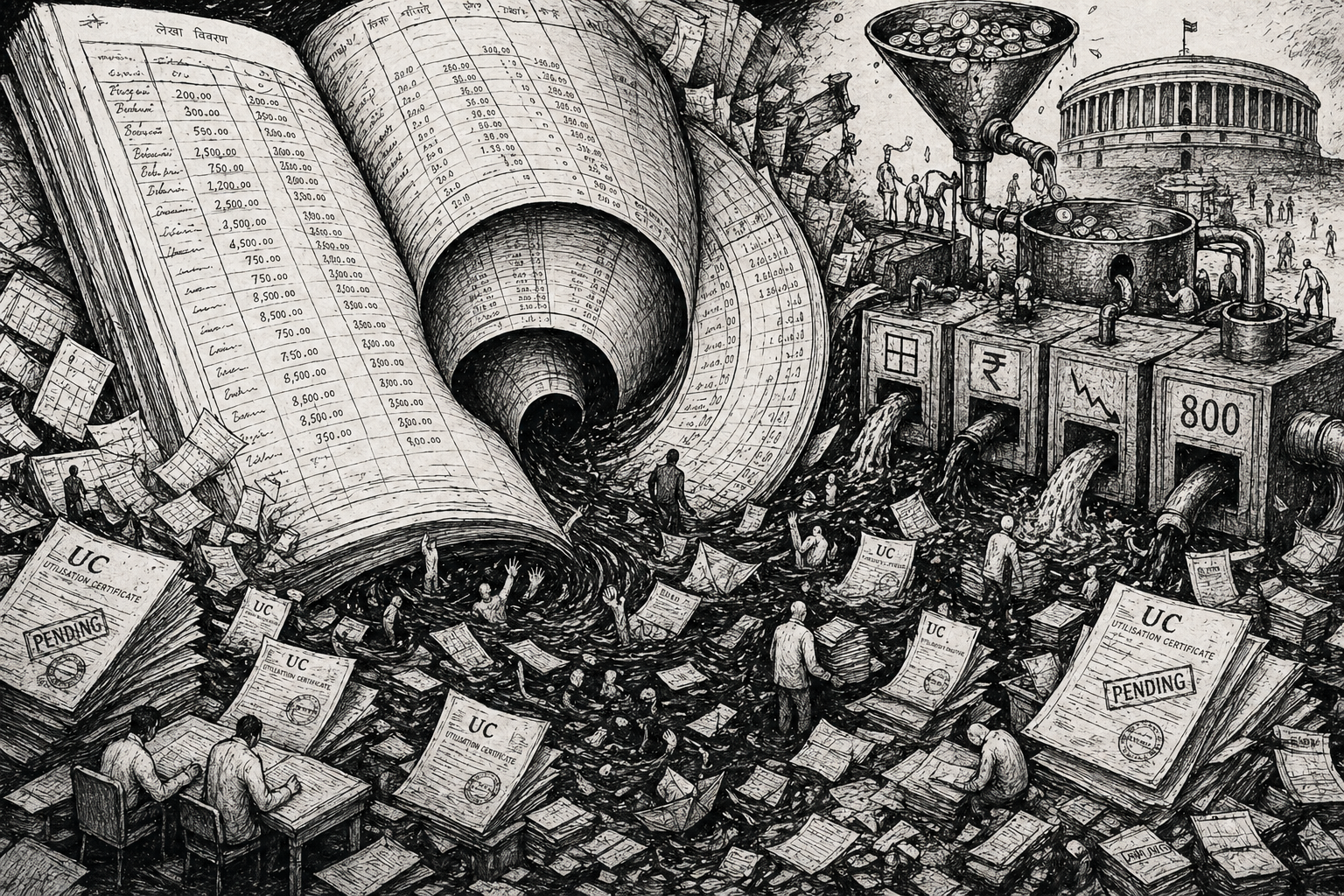
On 27 February, the Ministry of Statistics and Programme Implementation released India's new national accounts with a base year of 2022-23, replacing the old 2011-12 series. The revision revealed an economy of approximately ₹11.67 lakh crore in nominal terms compared to the one Parliament had voted expenditure against. Every fiscal ratio expressed as a percentage of GDP worsened mechanically, not because the government spent more, but because the denominator shrank. The fiscal deficit the Budget had pegged at 4.4 per cent of GDP for FY26 now stands at approximately 4.51 per cent. The debt-to-GDP ratio for FY27, budgeted at 55.6 per cent, has risen to approximately 57.5 per cent. To meet the 4.3 per cent fiscal deficit target for FY27, as approved by Parliament, the economy now needs nominal growth of 13 to 14 per cent rather than the 10 per cent assumed in the Budget.
Twenty-six days separated the Budget from the revision. In that gap lies a story about the design of India's fiscal governance architecture, the statistical credibility of a decade's worth of growth claims, and a sequencing choice that Parliament was never given the chance to question.
A revision unlike any that came before
India periodically updates the base year of its national accounts to reflect structural changes in the economy, incorporate new data sources, and align with international statistical standards. This is normal statistical practice. The last revision, released on January 30, 2015, shifted the base year from 2004-05 to 2011-12 and was issued 29 days before Budget 2015-16. Finance Minister Arun Jaitley incorporated the new numbers directly into his Budget speech, citing the revised growth trajectory. Parliament received fiscal projections that were consistent with the current statistical framework.
In 2026, the sequence was inverted. The Budget came first, on 1 February. The revision came after, on 27 February. This is, as far as the available record shows, historically unprecedented for a major base year revision in India.
The timing was not a surprise. Finance Minister Sitharaman herself announced in Parliament on 3 December 2025 that the new series would take effect on 27 February 2026. The Advisory Committee on National Accounts Statistics, chaired by Professor B.N. Goldar of the Institute of Economic Growth, had been working for two years. Three discussion papers had been published for public comment, with the third released on 23 January 2026, just nine days before the Budget, with a feedback deadline of February 5, four days after the Budget was presented. MoSPI had placed the 27 February date on its Advance Release Calendar months earlier.
The government presented fiscal projections to Parliament on February 1 using a GDP series it had publicly committed to replacing on February 27. The only question worth asking is why.
What the new numbers actually show
The technical details of the revision matter for understanding its fiscal consequences, and also because the methodology changes are substantial enough to alter how we should interpret a decade's worth of growth data.
The most consequential change is the shift from single deflation to double deflation. Under the old method, a single price index, typically the Wholesale Price Index, was used to convert nominal output into real output. The same deflator was applied to both what producers sold and what they bought as inputs. Under the new method, output and intermediate consumption are deflated separately using their respective price indices, with the deflator basket expanded from roughly 180 items to 500 to 600 items. When input commodity prices fall faster than output prices, as they often did between 2011 and 2025, double deflation reveals that producers were adding more real value than single deflation would suggest. This is why real GDP growth for FY26 was revised upward to 7.6 per cent from the previously estimated 7.4 per cent, and why manufacturing output shows substantially stronger real growth under the new series.
At the same time, the revision integrated major new data sources: GST data for private corporate sector allocation, the Annual Survey of Unincorporated Sector Enterprises for direct annual measurement of the informal economy, the Periodic Labour Force Survey for household sector estimation, the Household Consumption Expenditure Survey 2023-24 for recalibrated consumption weights, the MCA-21 database to split multi-activity corporations across their actual activities rather than classifying them under a single dominant sector, and the e-Vahan vehicle registration database for transport services. It also adopted NIC-2025, the new national industrial classification, which explicitly covers cloud services, platform intermediation, fintech, gig work, and AYUSH healthcare that NIC-2008 was unable to capture systematically.
The result is a statistical framework that is, by all accounts, more accurate. But the consequence of improved accuracy in this case is a smaller nominal economy. India's nominal GDP for FY26 under the new series is ₹345.47 lakh crore, compared to approximately ₹357.14 lakh crore under the old first advance estimate, a reduction of 3.26 percent. FY25 nominal GDP fell by approximately 3.8 percent, as did FY24. The base year itself was established at ₹261.18 lakh crore for FY 2022-23.
This downward revision of nominal GDP is the opposite of what typically happens during rebasing. The 2015 revision boosted India's GDP in current-price terms by roughly $120 billion. Improved data capture generally expands the estimated size of the economy, because better surveys and administrative data reveal previously unmeasured activity. The fact that the 2026 revision shrank nominal GDP while simultaneously finding faster real growth points to something specific: the old methodology was overstating the current-price value of economic activity, probably by using formal-sector data as an upward proxy for the much larger informal and household sectors.
The FY24 growth revision makes this point most sharply. Real GDP growth for FY 2023-24 was revised from 9.2 per cent to 7.2 per cent, a cut of two full percentage points. This was the year the government repeatedly cited as evidence of India's economic breakout, a year it described as confirming India's status as the fastest-growing major economy. The 9.2 per cent figure was cited in parliamentary debates, international forums, and by the Finance Ministry in defence of its policies. The new series says that the year grew at 7.2 per cent. These are not small rounding differences. They are a meaningful correction to the historical record.
The case that the critics had right
The FY24 revision does not arrive in isolation. It lands in the middle of an ongoing debate about the reliability of India's GDP methodology, which has been building for the better part of a decade.
In March 2026, a working paper by Abhishek Anand, Josh Felman, and Arvind Subramanian at the Peterson Institute for International Economics argued that India's GDP growth had been overestimated by 1.5 to 2 percentage points annually between 2012 and 2023, placing actual growth closer to 4 to 4.5 per cent rather than the official average of roughly 6 per cent. Their argument rested on two observations: the formal sector was being used as a proxy for the informal sector, which was disproportionately damaged by demonetisation, the GST transition, and COVID; and the WPI-based deflators used to convert nominal output into real output diverged significantly from actual output prices during this period, artificially inflating measured real growth.
Subramanian is not a disinterested critic. He served as Chief Economic Adviser between 2014 and 2018, a period covered by his own critique, and his 2019 paper on GDP overestimation attracted fierce pushback from within the government. But the direction of the FY24 revision is consistent with his framework, and the Newslaundry analysis from March 14, 2026 found that private consumption expenditure across FY23 to FY26 is ₹80.7 lakh crore lower, approximately 10.5 percent less, under the new series than the old, with the share of private consumption in GDP contracting from 60 to 61 percent to 56 to 57 percent. That compression in consumption is not what an economy growing at 9.2 percent in FY24 would typically show.
Dr Pronab Sen, India's first Chief Statistician, was more measured in his response to the revision but acknowledged that the 2023-24 data under the new series "conforms much more closely to our expectations than the data we are seeing now" under the old. That is the kind of assessment that carries weight precisely because it comes from someone who helped build the system being corrected.
The IMF had flagged these concerns formally in its 2025 Article IV Consultation, assigning India a C grade for national accounts data quality, the second-lowest in its four-tier framework. The specific complaints were familiar: the outdated base year, single deflation rather than double deflation, the use of the WPI rather than the Producer Price Index, large discrepancies between production-side and expenditure-side GDP calculations, the absence of seasonally adjusted data, and weak measurement of the informal sector. Finance Minister Sitharaman defended the institution in Parliament in December 2025, noting that the C grade was specifically attributable to the outdated base year and that the growth figures themselves had not been questioned. The new series corrected the base year. It also revised the growth figures.
What Parliament should have known
The constitutional requirement for the Budget is set out in Article 112 of the Indian Constitution, which requires the President to cause a statement of estimated receipts and expenditure to be laid before Parliament for each financial year. The legal text concerns absolute rupee amounts, not GDP-denominated ratios. In a narrow technical sense, the Budget's constitutional validity is unaffected by the GDP revision: the Demands for Grants that Parliament votes on are in rupees, and the rupee has not changed.
But this technical answer is misleading about the substance of the problem. The fiscal deficit as a percentage of GDP is not a constitutional requirement; it is the central metric through which parliamentary debate on fiscal prudence is organised and through which India's fiscal commitments to international bodies, credit rating agencies, and states are communicated. When that metric shifts by 15 basis points within weeks of a Budget vote, the information basis for parliamentary scrutiny is materially altered, and Parliament had no way to ask the questions it should have been able to ask.
The deeper problem lies in the Fiscal Responsibility and Budget Management Act of 2003. Section 3(2) of the FRBM requires the Central Government to table alongside the Budget a Medium-Term Fiscal Policy Statement setting out three-year rolling targets for revenue deficit, fiscal deficit, tax-to-GDP ratio, and total outstanding liabilities, all expressed as a percentage of GDP at market prices. A Macroeconomic Framework Statement and a Fiscal Policy Strategy Statement are also required.
Budget 2026-27 assumed nominal GDP growth of 10 per cent for FY27, projecting a nominal GDP of approximately ₹393 lakh crore. Against that denominator, the fiscal deficit target of ₹16.95 lakh crore represented 4.3 per cent of GDP. The medium-term debt target was 50 per cent plus or minus one per cent of GDP by FY 2030-31, with FY27 debt at 55.6 per cent.
When nominal GDP was revised downward by 3.3 per cent on February 27, all of these statutory projections simultaneously became stale. The absolute fiscal deficit amount in rupees did not change. But at the new-series nominal GDP level, the same rupee amount now represents a higher fraction of a smaller economy. ICRA Chief Economist Aditi Nayar calculated the revised FY27 fiscal deficit at approximately 4.46 per cent of GDP, assuming 10 per cent nominal growth. SBICAPS research reached a starker conclusion: to hit the budgeted 4.3 per cent target on the new-series base, nominal GDP would need to grow at 13.7 per cent, a figure the research described as "difficult" even under the Chief Economic Adviser's own projections of 7 to 7.4 per cent real growth for FY27.
The FRBM Act has no provision for this scenario. There is no mechanism requiring recertification when the GDP denominator changes. There is no requirement to table revised projections. There is no disclosure obligation. The Medium-Term Fiscal Policy Statement tabled on 1 February became technically obsolete by 27 February, and the government responded to a written parliamentary question on the matter on or about 10 March, through the Minister of State for Finance. No revised MTFPS was tabled. No revised fiscal strategy statement was circulated.
D.K. Srivastava, Chief Policy Advisor at EY India, stated on the day of the revision: "Since fiscal deficit is calculated as a share of GDP, a lower GDP base automatically pushes the ratio up, raising the 2025-26 revised estimate fiscal deficit from 4.36 percent to 4.51 percent of GDP even though the deficit amount itself is unchanged." The CEA Anantha Nageswaran acknowledged the change, noting the revised FY26 deficit was "likely at 4.5 percent of GDP as against 4.4 percent in the revised estimates." The government had absorbed the revision and adjusted its communications. What it had not done was return to Parliament with updated numbers.
The RBI's more honest response
The contrast between the Finance Ministry's approach and the Reserve Bank's is instructive. The Monetary Policy Committee met February 4 to 6, 2026, three days after the Budget and three weeks before the GDP revision. It held the repo rate at 5.25 per cent and projected FY26 growth at 7.4 per cent under the old series. Governor Sanjay Malhotra stated explicitly that the full-year FY27 growth projections would be deferred to the April 2026 policy review, because the new GDP series was scheduled for release in late February and forward guidance issued before that release would be premature.
The central bank acknowledged in public that it could not provide meaningful projections using the statistical framework about to be replaced. It waited. The Finance Ministry, working under a tighter constraint because the constitutional Budget calendar does not move, presented projections on February 1 and allowed the calendar to proceed.
The RBI's deferral is worth sitting with. A monetary institution responsible for setting the price of credit for the entire economy decided it could not responsibly project forward until the statistical basis was updated. The fiscal institution responsible for presenting the government's spending and borrowing plan to Parliament did not defer and did not disclose the pending revision in any meaningful way in the Budget speech itself.
The state government cascade
The consequences of the nominal GDP revision do not stop at the Centre. Under FRBM norms, state borrowing limits are set at 3 per cent of Gross State Product. If GSDP denominators are revised downward proportionally to the national revision, the absolute borrowing room available to every state government shrinks mechanically.
A MoSPI official acknowledged the uncertainty frankly: "If a state's GSDP changes, its borrowing powers under the FRBM will also change. The GDP change will trigger many changes, not just in budget estimates, but in many other areas, and those areas we do not know for sure at this point in time."
As of mid-March 2026, no state GSDP revisions had been released. The Deccan Chronicle reported that Tamil Nadu economists raised concerns about the potential impact on capital allocation and borrowing headroom. High-debt states face the sharpest exposure. Punjab carries a debt-to-GSDP ratio of approximately 46.6 per cent, and Himachal Pradesh approximately 45.2 per cent; both are already operating near FRBM limits. Kerala is in active litigation in the Supreme Court over the Centre's Net Borrowing Ceiling, which is set as a percentage of GSDP. If GSDP shrinks, the borrowing ceiling shrinks with it, regardless of the state's actual fiscal management.
Finance Commission transfers are also indirectly affected because the horizontal devolution formula uses per capita GSDP as one of its equity criteria. If state GSDPs are revised on a methodology that disproportionately corrects certain sectors, the distributional balance of central transfers could shift before anyone has had the chance to examine whether the revised figures accurately reflect each state's economic reality.
The back series problem
The new GDP series covers only FY 2022-23 onwards. The full back series, extending to 1950-51, is expected only by December 2026. The Sources and Methods publication detailing the complete methodology is scheduled for August 2026.
This means that for approximately ten months, no historical comparison is possible between the new series and pre-2022-23 data. Trend growth calculations, long-run fiscal analysis, structural break assessments, and comparisons of the current government's economic performance against previous administrations are all suspended pending the back series. The claims of the 2024-25 Economic Survey about the decade-long structural transformation cannot be evaluated against a consistent statistical baseline. The Budget's own narrative about the economy's trajectory since 2014 rests on a GDP series now under revision.
The IMF's 2025 Article IV report noted, in what turned out to be prescient language: "Following the rebasing of GDP in February 2026, it would be appropriate to revisit the debt target, with a view to making it more ambitious." That revisitation has not yet happened in any formal way. The debt consolidation path to 50 per cent by FY31, announced with considerable fanfare, is now more ambitious than presented because the starting point is higher. The government has not said so explicitly.
What makes this different from routine revision
It is worth being precise about what the critique here is and what it is not.
Base year revisions are standard statistical practice and, on balance, improve the quality of India's macroeconomic data. The shift to double deflation, the integration of ASUSE and HCES data, the adoption of NIC-2025, the use of Supply-Use Tables to reduce production-expenditure discrepancies: these are genuine methodological advances. The ACNAS process under Professor Goldar involved 26 members, 56 experts, 40 meetings, three public discussion papers, and three consultative workshops. This is not the rushed or politically motivated exercise that critics of earlier revisions sometimes described.
Nor is the argument that a smaller nominal GDP is inherently bad news. It is a more accurate measurement. A smaller but more accurately measured economy is preferable to a larger but misrepresented one. The 9.2 per cent growth figure for FY24 was a number that strained credibility at the time; the revision to 7.2 per cent is a correction, not a catastrophe.
The critique is specifically about sequencing and disclosure. The government knew the revision was coming on 27 February. It knew the 27 February release would change every fiscal ratio in the Budget. It presented the Budget on 1 February without disclosing, in any meaningful way, that the fiscal arithmetic Parliament was being asked to approve was calculated against a denominator with a known 26-day lifespan. The FRBM statements tabled alongside the Budget made no mention of the imminent revision. The Budget speech made no mention of it. The Economic Survey, released the evening before the Budget, made a passing reference to the upcoming revision without quantifying its fiscal implications.
The contrast with 2015 is instructive not just as a matter of precedent but as a matter of institutional design. In 2015, the revision came first, and the Budget incorporated it. The sequence ensured that Parliament's financial scrutiny took place within the current statistical framework. In 2026, the sequence was reversed, and Parliament approved a medium-term fiscal consolidation path that was already inconsistent with current statistical data before the ink was dry.
The governance question that does not go away
What should have happened? The 27 February release date was locked in well before the Budget session. The feedback deadline for the third ACNAS discussion paper was 5 February, four days after the Budget. Had MoSPI advanced the release date to, say, 20 January, the Budget could have incorporated the new GDP figures. Alternatively, the Finance Ministry could have included in the Budget speech, or in the accompanying FRBM statements, a transparent disclosure: the fiscal ratios presented here are calculated on the 2011-12 base series; the new 2022-23 base series will be released February 27 and will revise these ratios, and here is our best estimate of those revisions.
Neither option was chosen. This is a governance choice, and governance choices about statistical sequencing have a politics. In 2015, the revision came before the Budget and inflated GDP, making fiscal ratios look better and allowing the Budget speech to present more favourable numbers than the old series would have allowed. In 2026, the revision came after the Budget and reduced nominal GDP, worsening fiscal ratios. If the sequence were reversed and the revision had come before Budget 2026, the Finance Minister would have had to present a fiscal deficit of 4.5 per cent and a debt-to-GDP of 57.5 per cent, rather than 4.4 per cent and 55.6 per cent, as this year's starting point. The consolidation path would have appeared steeper from the outset.
The FRBM Act, as currently drafted, provides no remedy for this. It requires disclosure, not correctness. The Medium-Term Fiscal Policy Statement is tabled and voted on, and if the denominator changes the following week, there is no legal mechanism requiring updated projections to be tabled. This is a gap in the legislation that the Fifteenth and Sixteenth Finance Commissions have not addressed, that the NK Singh committee's 2017 review of the FRBM did not address, and that the upcoming Budget session will presumably not address either. Fixing it would require either a statutory amendment mandating that the government table revised FRBM statements within a specified period following major statistical revisions, or a convention requiring the Finance Minister to disclose known imminent revisions in the Budget speech itself.
The denominator and the people who live below it
There is a tendency in writing about GDP methodology to treat it as a technical question with purely technical consequences: statistical offices improving their measurement frameworks, government treasuries adjusting their borrowing plans, rating agencies updating their debt models. This framing is incomplete.
The fiscal ratios presented in the Budget are not merely accounting identities. They are the political arithmetic through which the government justifies spending decisions. When health expenditure as a percentage of GDP appears to edge upward because the GDP denominator shrank rather than because health spending increased, that appearance matters. It matters for the parliamentary debates in which the Opposition argues that health underspending is chronic, and the Treasury Bench argues that the ratio is improving. It matters for the IMF Article IV consultation in which India's social sector commitments are assessed. It matters for the Finance Commission deliberations in which states argue for greater health devolution.
Social spending ratios will now look somewhat better under the new series purely as an arithmetic consequence of the smaller denominator, with no change in actual allocations. Government health expenditure at approximately 2.6 per cent of GDP under the old series edges closer to the National Health Policy's 2.5 per cent target, not because the government spent more on health, but because the economy is now measured as smaller. Education spending at approximately 4.6 per cent of GDP moves closer to the Kothari Commission's recommended 6 per cent of GDP threshold, again arithmetically rather than substantively. As yet, no systematic analysis of the revised social spending ratios under the new base has been published. That gap should be filled before the next Budget.
The fiscal consolidation path that worsened on February 27 will now require, by most analysts' estimates, either higher nominal growth than the Budget assumed, additional revenue mobilisation, or expenditure compression below the levels Parliament approved. The history of Indian fiscal consolidation under pressure suggests the compression tends to fall on capital expenditure and social sector spending rather than on revenue expenditure, subsidies, or interest payments. States already under fiscal pressure from GST compensation expiry, MGNREGA cuts, and the constraints of the Net Borrowing Ceiling now face borrowing limits that will shrink further when GSDP is revised. The people most exposed to state fiscal tightening are the people most dependent on state delivery of health, Eeducation, food, and employment: the rural poor, the urban informal worker, the MGNREGA beneficiary, the ASHA and Anganwadi worker paid below minimum wage by state governments stretched thin.
GDP methodology is never neutral. Measuring the economy accurately is better than measuring it inaccurately. But the timing of when the more accurate measurement is disclosed, and to whom, and in what context, is a choice. That choice was made in a way that insulated a Budget presentation from scrutiny under current statistics. That is worth noting and worth correcting.
What would adequate governance look like here?
The problems described in this article are not technically difficult to solve. They require political will and institutional design, not new data or expertise.
On sequencing: the simplest fix is a convention, ideally backed by a statutory amendment to the FRBM Act, requiring that any base year revision whose release date falls within 60 days of the Budget presentation must either precede the Budget or be accompanied by a disclosure in the Budget speech quantifying the projected impact on all statutory FRBM ratios. The RBI's February deferral of forward guidance shows that this kind of honest sequencing is possible when an institution chooses it. The Finance Ministry should be held to the same standard.
On the FRBM gap: Section 3(2) of the Act should be amended to require the government to table a revised Medium-Term Fiscal Policy Statement within 30 days of any major revision to the GDP series that increases or decreases the fiscal deficit ratio by more than 10 basis points. This is a modest requirement. It simply asks that Parliament receive updated projections before it approves the Demands for Grants, which typically happen months after the Budget speech. The Budget Session runs until late April. The February 27 revision was known before any DFG vote. There was time to update Parliament. The choice not to do so was a choice.
On social spending ratios: MoSPI and the Finance Ministry should, alongside the next Budget, publish a reconciliation table showing social spending ratios under both the old and new GDP series for the past three years. This would allow Parliament and the public to distinguish genuine improvements in social sector spending from arithmetic improvements resulting from a smaller denominator. The National Health Policy target of 2.5 percent of GDP and the education target of 6 percent of GDP should both be restated in absolute per capita terms alongside the ratio, so that the measurement framework cannot be quietly satisfied through denominator reduction.
On state fiscal cascades: the Ministry of Finance should publish, before the end of this fiscal year, an estimate of the impact of GSDP revisions on state borrowing limits under the FRBM. States are being asked to plan capital expenditure and welfare commitments without knowing how the statistical revision will affect their legal borrowing headroom. This is a routine fiscal coordination failure of the kind that the Finance Commission framework was designed to prevent.
On the back series: the December 2026 deadline for the full back series should be treated as a hard commitment, not a planning estimate. Without historical comparability, the revised GDP series cannot perform its most important function, which is enabling accountability for policy choices made over the past decade. The ten-month gap in historical comparison is currently allowing the government to present FY24 growth as 7.2 per cent without that number sitting alongside the full revised trajectory that would contextualise it. The 2015 revision was also delayed in releasing a back series. It should not happen again.
None of these recommendations requires new money. They require the government to hold itself to the same standard of transparent disclosure it asks of the statistical offices it oversees.
Further Reading
On the new GDP series and its implications
MoSPI Press Note on New Series of GDP Estimates with Base Year 2022-23 — the primary document, released February 27, 2026.
MoSPI FAQ on the New GDP Series — published February 26, 2026; explains double deflation, NIC-2025, and ASUSE integration in accessible terms.
How Base-Year Revision Hit India's GDP, Fiscal Math — Explained, Outlook Business — best single-source summary of the fiscal ratio consequences, with the Arvind Subramanian vindication framing.
Newslaundry: The Case of the Missing Rs 80 Lakh Crore — on the ₹80.7 lakh crore contraction in private consumption under the new series.
India's 20 Years of GDP Misestimation: New Evidence, Peterson Institute for International Economics (Anand, Felman, Subramanian, 2026) — the working paper that the FY24 revision partly vindicates.
Government Revises Fiscal Deficit Ratios for FY23-FY25 After GDP Base Year Update, Business Standard, March 2026 — on the parliamentary confirmation of revised historical deficit ratios.
On India's fiscal governance framework
The Fiscal Responsibility and Budget Management Act, 2003 — the primary statute; Section 3(2) contains the MTFPS requirement.
Union Budget 2026-27 Analysis, PRS Legislative Research — the most systematic independent analysis of the Budget's fiscal arithmetic.
IMF Country Report No. 25/314: India — the 2025 Article IV Consultation that assigned India the C grade and flagged the outdated base year.
On the state borrowing and federalism implications
Changes in GDP Data Can Impact Borrowing Limits, Allocations, Deccan Chronicle, March 2026.
From Policy Grounds
The Arithmetic of Fiscal Centralisation — on how cesses, surcharges, and GST implementation have systematically compressed states' fiscal space, making them more vulnerable to exactly the kind of GSDP revision pressure described in this article.
Budget 2026-27 and the Reallocation from Women to Men — the BehanBox analysis of how the Budget's expenditure choices, before the GDP revision, already compressed welfare allocations; the revision makes the consolidation pressures that will follow even more consequential for these programmes.
Varna Sri Raman is a development economist and writes at policygrounds.press.




















Write a comment ...